
 Polski
 Čeština
 Slovenčina
 Deutsch
 Italiano
 Español
What is the Pigu marketplace and how do you start selling there?
More and more sellers are looking for markets that are less crowded and where demand is still growing. One of them is the Baltic region – Lithuania, Latvia and Estonia – where Pigu is the undisputed leader in online sales. If you’re wondering what exactly this platform is and whether it’s worth selling on, read on.
 Wojciech PiszczekCEO & Founder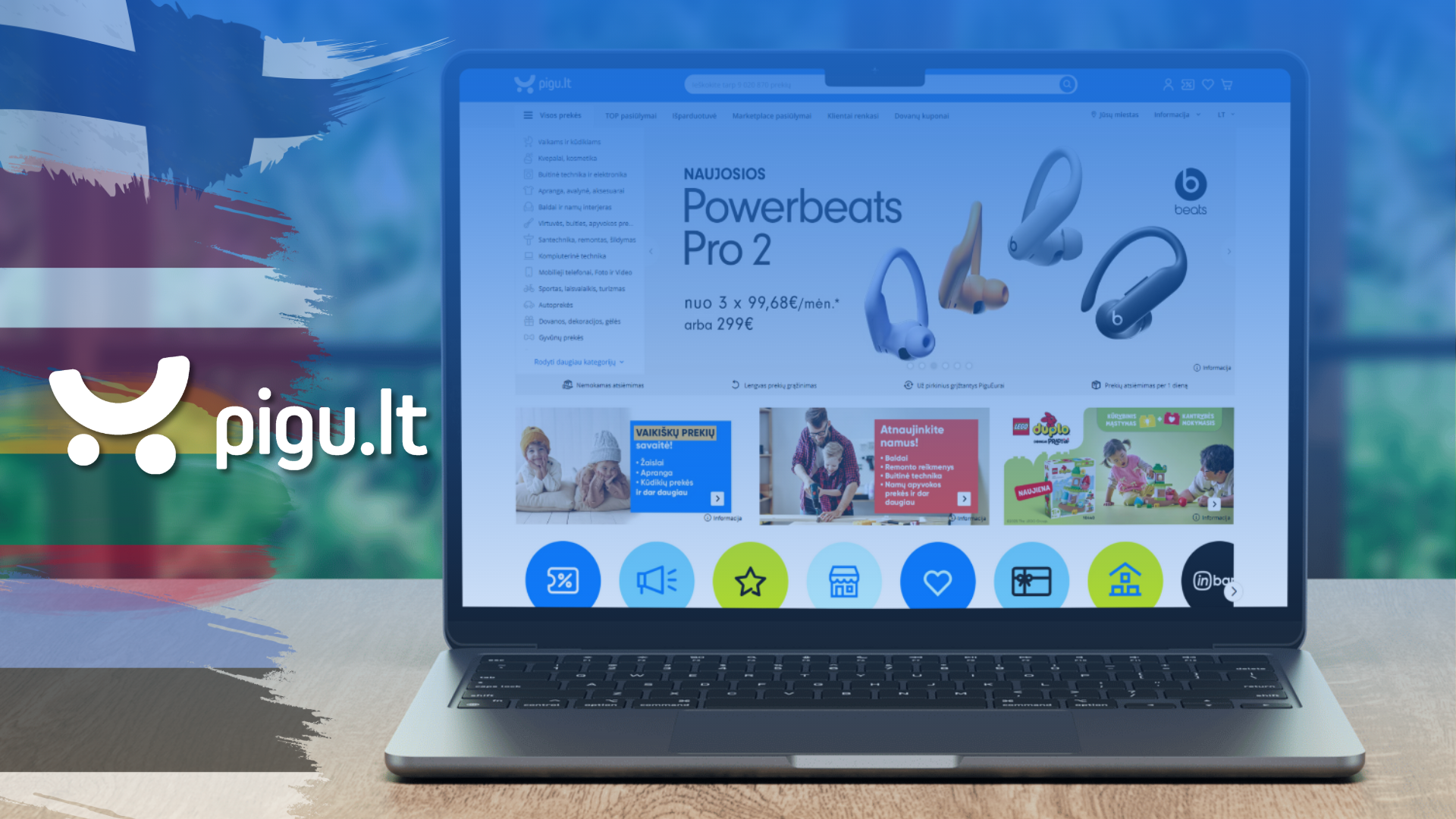
What is Pigu?
Pigu is the largest marketplace in the Baltic states. It operates in Lithuania, Latvia and Estonia, bringing three markets together in a single seller account. The name sounds so down-to-earth for a reason: in Lithuanian, ‘pigu’ simply means ‘cheap’. The platform started out as an online shop and over time grew into a fully fledged marketplace where, much like on Allegro or Amazon, third-party sellers offer their products alongside the platform’s own range.
Pigu is backed by PHH Group, which processed 8.5 million orders and generated more than €265 million in sales within five years of launching its Marketplace. That shows the scale we’re talking about: this is no little local shop, but a regional leader with a real customer base and real turnover.
For Polish sellers, Pigu is often the first step towards markets that hardly anyone thinks of first, yet which still have plenty of room for new players.
Which markets does Pigu operate in – Lithuania, Latvia, Estonia?
Pigu covers three countries: Lithuania (pigu.lt), Latvia (220.lv) and Estonia (kaup24.ee). All three platforms are integrated with one another, so by setting up a single seller account you list your products on all three markets at once, without registering separately in each of them.
 From a single seller account, you list your products on pigu.lt, 220.lv and kaup24.ee at the same time.
That’s a big difference compared with many other international expansions, where each country means a separate account, a separate seller dashboard and separate logistics. Here you have one shared system for managing listings, orders and payments across the whole region, which genuinely shortens the time it takes to get up and running and simplifies Pigu account management.
In total, Pigu says it offers access to around 11.5 million potential customers and more than 6 million active buyers in the Baltic region. These countries are small in terms of population, but they have a growing appetite for online shopping. GMV across Pigu’s Baltic markets rose by 17% year on year in 2024, which shows this is not a market standing still.
How much does it cost to sell on Pigu?
Selling on Pigu involves two main costs: a fixed monthly subscription and a sales commission that depends on the product category. The benchmark is a subscription of €39 a month. However, marketplace price lists change fairly regularly, so it’s always worth confirming the current rate directly with Pigu or with an agency that keeps track of such changes as they happen.
Cost item | Indicative amount | Notes |
|---|---|---|
Monthly subscription | from €39/month | depends on the package; worth checking the current price list |
Sales commission | depends on the category | a similar model to Allegro or Amazon |
Listing translations | one-off or recurring cost | Lithuanian, Latvian, Estonian |
Logistics / fulfillment | optional | Pigu offers its own fulfillment solutions |
So the real cost of entry depends on how many products you have, which categories they are in and whether you do the translations once or update them regularly.
How do you register a seller account on Pigu?
Registering a seller account on Pigu is a multi-step process which, if you move efficiently, can be completed within a few weeks. It isn’t fundamentally different from getting started on other marketplaces, but it does have its own particularities, linked to the fact that your listings have to be multilingual.
- Setting up a seller account and providing your company details, including your VAT number for the OSS scheme when selling cross-border.
- Translating your listings into Lithuanian, Latvian and Estonian – the quality of the translation directly affects buyer trust.
- Configuring delivery and returns options for all three markets at once.
- Choosing an invoicing method and integrating payments.
- Adding products and getting through Pigu’s first review of your listings.
- Starting to sell and monitoring your results on an ongoing basis.
The most common bottleneck isn’t the formalities but the translations themselves. Machine translation will cope with a simple description, but with technical specifications it’s easy to make a mistake that costs you the customer’s trust before they’ve even clicked ‘Buy now’.
How is Pigu different from Amazon or Allegro?
Pigu is a much smaller market than Amazon, but it also has far less competition. If you’re looking for a comparison, Pigu is a bit like an Allegro for three Baltic states at once: one clear leader that customers return to out of habit rather than necessity.
Feature | Pigu | Amazon | Allegro |
|---|---|---|---|
Reach | 3 Baltic states | global | mainly Poland (+ CZ, SK) |
Competition between sellers | lower | very high | high |
Barrier to entry | low/medium | medium/high | low |
Listing language | LT, LV, EE | multilingual | PL |
Less competition doesn’t mean easy sales without any effort, but it does mean that a new seller has a real chance of standing out faster than on crowded Amazon. At Raise Your Sales, this is exactly how we see Pigu: as a market for businesses that want to diversify their sales without jumping straight into Europe’s most crowded platforms.
Which products sell best on Pigu?
Electronics, fashion, homeware and toys sell best – these are the main categories in which Pigu is building its position as the region’s leader. Sellers in these sectors benefit from the fact that Baltic customers have got used to buying precisely these categories on Pigu instead of looking for them elsewhere.
For sellers, this means one thing: if your product falls into electronics, fashion or homeware, you’re entering a market where customers are already in the habit of buying. If you sell something more niche, there’s less ready-made demand, but also fewer competitors who have got there before you.
Who is selling on Pigu right for?
Pigu works best for businesses that want to diversify their sales but don’t have the resources to build a separate set-up for three countries at once from scratch. It’s a market for sellers who have already found their feet on Allegro or Amazon and are looking for another source of revenue rather than betting everything on a single platform.
It is also a good fit for businesses whose products suit the electronics, fashion or home categories but who don’t have anyone on the team who knows the Baltic market inside out. Integrating three countries under one account genuinely lowers the barrier to entry, which in a conventional international expansion is often the main reason decisions get put off.
It is less suited to businesses counting on an immediate, large-scale return on investment. The Baltic market is several times smaller than the German or Polish market, so the scale of sales will be different too, although profitability can be surprisingly good.
Less competition in the Baltic markets doesn’t mean it’s worth throwing everything at them straight away. At Raise Your Sales, we ourselves usually only take a client onto Pigu once they already have a dozen or so other, smaller marketplaces well looked after. The Baltic market is still not as developed as Amazon or Allegro, so on its own it rarely justifies building an entire expansion strategy around it. Even so, it’s worth getting there before your competitors, so you can start building visibility and a position before the market matures. It’s a long game, not a bid for instant results.
How do you start selling on Pigu?
Starting to sell on Pigu takes three things: a seller account, translated listings and a basic knowledge of local shopping habits in three different countries at once. You can do this yourself, but in practice it’s the translations and tailoring your offer to the specifics of each market that take up the most time.
This is the point at which many sellers decide to bring in an agency, so they don’t have to learn everything by trial and error on a live account.
Summary
Selling on Pigu is essentially a bet that a smaller market with less competition can deliver more than yet another platform where you have to fight your way through thousands of listings similar to yours. Three countries under one account, GMV growing at a low double-digit rate year on year and customers used to buying specific categories – that’s a foundation on which it’s easier to build sales than by starting everything from scratch in a crowded market.
Wondering whether your products stand a chance in the Baltic market? Book a free consultation, and we’ll assess your sales potential on Pigu together and suggest where to start.
Did you find this article helpful?
This article has no ratings yet — be the first.
Autor
Wojciech Piszczek
CEO & Founder
I’ve been immersed in e-commerce for more than ten years, with a core focus on helping brands scale onto international platforms like Amazon, eBay, Kaufland, and eMAG. My experience covers the entire sales lifecycle—from high-level strategy and logistics to marketing and conversion optimisation. I help businesses not only enter new markets but scale sustainably, ensuring they avoid the costly pitfalls often faced by those just starting out.