
 Polski
 Čeština
 Slovenčina
 Deutsch
 Italiano
 Español
Selling to Germany: how to start and what market entry really costs
You have a good product. It sells in Poland, it gets repeat orders and your stock keeps moving. And at some point the question comes up that every manufacturer and distributor asks sooner or later: ‘What if we crossed the Oder into Germany?’
 Wojciech PiszczekCEO & Founder
That question usually goes unanswered. Not because the German market is closed. Quite the opposite: it’s right next door, bigger than the Polish market and hungry for products. It goes unanswered because everything beyond the border is shrouded in fog: a different language, different regulations, LUCID, VAT, some VerpackG thing that someone once mentioned at a conference. It’s easier to put the whole thing off until ‘some day’.
The problem is that ‘some day’ means the same customer in Cologne or Munich will buy from someone else in the meantime. Germany is the nearest large market a Polish business can realistically enter, and you don’t need a corporate budget to do it. You need a plan. This article is that plan: from ‘is it even worth it?’, through choosing a platform and working out the costs, to the formalities and how long it takes to get in. Let’s get started.
Is selling to Germany worth it for a Polish business?
Yes, and more so than most businesses assume. Germany is Europe’s largest e-commerce market, worth around €92 billion a year and still growing by a few per cent year on year. For a Polish manufacturer, that means access to customers with greater purchasing power who are used to shopping online and happy to pay good money for good quality.
The key advantage is geography. Germany is right next door, so logistics are cheap and fast, and products arrive within 2–3 days. No customs duties, no customs clearance, no exotic exchange rate. Same continent, same EU, just a market several times the size.
There is one condition. The German market is mature and demanding. Customers expect descriptions in German, efficient service and hassle-free returns. Businesses that treat Germany as ‘Poland, only further away’ hit a wall. Those that take it seriously, for example by outsourcing their Amazon account management to specialists, find a second source of revenue there, often bigger than their home market.
Where should you start when selling to Germany?
Start by choosing one platform and one logistics model, rather than trying to be everywhere at once. The most common mistake is trying to launch on Amazon, Kaufland and your own online shop in the same month. The outcome is always the same: scattered focus, a burnt budget and nothing to show for it. It’s better to master one channel, make it profitable and only then add more.
The order matters, because some steps will block your sales if you skip them. You can’t register to sell without a LUCID number, and you can’t work out your price without knowing the commission and the cost of returns. That’s why the formalities are dealt with at the start, not ‘along the way’.
Here are the first six steps, in a sensible order:
- Validate your product’s potential. Check demand, competition and prices in the German category. If competitors are selling for less than it costs you, there’s no point going any further.
- Pick one platform to start with. Usually Amazon.de or Kaufland.de (more on choosing below).
- Register with LUCID and sign a contract with a dual system. This has to be done before your first shipment.
- Sort out VAT. Find out whether you exceed the €10,000 EU distance-selling threshold and whether you’re planning a warehouse in Germany.
- Localise your listings into German. Not a word-for-word translation, but correct, natural-sounding copy.
- Set up logistics and returns. Choose a carrier and be ready for the 14-day right of return.
Where to sell in Germany: Amazon.de, Kaufland.de, eBay or Otto?
For most Polish businesses, the best place to start is Amazon.de or Kaufland.de, with eBay and Otto playing a supporting role. Amazon.de is Germany’s main shopping street: all the footfall is there, but so is all the competition, standing right next to your listing. Kaufland.de is more like a quieter shopping arcade: less footfall, but also thinner competition and an easier way in, which is why it often delivers first results faster.
The choice depends on your product category, your margin and how hard you’re prepared to fight for visibility. The table below shows how they differ.
Platform | Sales commission | Monthly fee | Best for / product type | Barrier to entry |
|---|---|---|---|---|
Amazon.de | 8–15% by category | approx. €39 (Pro plan) | Highest traffic, almost every category, brands ready to take on the competition | Medium/high |
Kaufland.de | 4–16% by category | approx. €39.95 | Home, garden, sport, cleaning products, a good channel to start with | Low (easier approval) |
eBay.de | approx. 10–12% | Optional shop from a few euros | Niches, spare parts, long-tail products, including second-hand | Low |
Otto.de | approx. 15% or more | By individual agreement | Well-known brands, home and fashion, verification required | High (by invitation) |
Which marketplace in Germany should you start with?
If you sell products for the home or garden and want a quick first result, start with Kaufland.de. Competition there is thinner than on Amazon, and a single registration opens up several markets at once. If, on the other hand, your category lives mainly on Amazon and you have an advertising budget, go straight to Amazon.de, because that’s where the most traffic is.
At Raise Your Sales, we most often recommend a ‘one channel first, then diversify’ approach. One upholstered furniture manufacturer we worked with started out on Kaufland.de and increased its sales by 6,000% in four months, from a very low base. That illustrates a mechanism, not a rule: a well-chosen platform with thinner competition can deliver results faster than throwing yourself straight into the most crowded market.
How much does it cost to enter the German market?
The real cost of launching on one platform is usually a few hundred to around two thousand euros to get up and running, plus fixed monthly costs, not tens of thousands. Contrary to popular belief, entering Germany doesn’t require a corporate budget. What it does require is costing out every item, because the devil is in the commission, the returns and the recycling fee, not in the subscription itself.
Below is a breakdown of the costs you need to factor in before you set your product’s price.
Item | One-off cost | Recurring cost |
|---|---|---|
LUCID registration | €0 (free) | - |
Dual system licence (recycling) | - | Based on packaging weight, from a few dozen euros a year upwards |
Platform subscription | - | approx. €39–40/month |
VAT registration in Germany (if warehousing in Germany) | Accountant’s fees | Monthly/quarterly returns |
Localising listings into German | One-off, per product | - |
Logistics / shipping | - | from approx. PLN 30–50 net per parcel |
Advertising (Ads) at launch | - | from approx. €200–300/month |
What are the legal requirements for selling to Germany?
There are four obligations you can’t get around: packaging registration (VerpackG/LUCID), registration of electronics and batteries (ElektroG), VAT, and the information you must provide in your listings (the Impressum, or legal notice, and the right of return). This isn’t a list of ‘best practices’. These are conditions without which the platform will simply block your listings.
Most businesses trip up on VerpackG, because it sounds abstract but has real teeth. Think of it like compulsory car insurance: nobody likes paying for it, but without it you’re not allowed on the road. Electronics and batteries have their own register (WEEE/EAR), and if you sell such products, you have to register there separately. On top of that come your obligations to consumers: a clear Impressum, terms and conditions, and information about the right of return.
It sounds like a lot. In practice, it’s a checklist you tick off once at the start and keep an eye on whenever something changes. Skipping it is worse than doing it, because a fine can exceed a whole year’s profit from the market.
What are VerpackG and LUCID registration?
VerpackG is the German Packaging Act, and LUCID is the central packaging register run by the ZSVR, in which every business placing packaged goods on the German market must be listed. Registering with LUCID itself is free and takes up to a few days. Separately, you sign a paid contract with a so-called dual system, which takes care of recycling, and that’s the real cost.
There’s no threshold that would exempt you. Even a single parcel to a German consumer triggers the obligation. Note that Poland’s BDO packaging and waste register and Germany’s LUCID are two separate systems, so registering in Poland doesn’t cover you across the border.
The stakes are high if you ignore this. Failing to register can mean fines running into hundreds of thousands of euros, and platforms block listings from sellers without a LUCID number. It’s the most expensive way imaginable to learn about German bureaucracy.
When do you need to register for VAT in Germany?
You need to register for VAT in Germany when you store goods there, for example in an Amazon FBA warehouse. Simply shipping parcels from Poland doesn’t require it, as long as you stay within the EU distance-selling threshold of €10,000 a year, calculated across all your cross-border B2C sales combined.
Once you exceed that threshold, you have a choice. You can account for German VAT through the OSS scheme, filing a single return in Poland instead of registering in each country separately. It’s a major simplification and, for most businesses shipping from Poland, a perfectly adequate solution.
OSS stops being enough the moment you decide on a local warehouse. Holding stock in Germany always means a separate German VAT registration, regardless of turnover. That’s why the ‘ship from Poland or from a warehouse in Germany?’ decision should be made deliberately, as it has specific tax consequences.
How does distance selling to Germany work?
Distance selling to Germany comes in two models: you either ship parcels directly from Poland, or you keep stock in a German warehouse (e.g. Amazon FBA) and fulfil orders from there. Shipping from Poland is simpler and cheaper at the start, because it doesn’t require German VAT registration. A warehouse in Germany shortens delivery times and improves the visibility of your listings, but adds paperwork and cost.
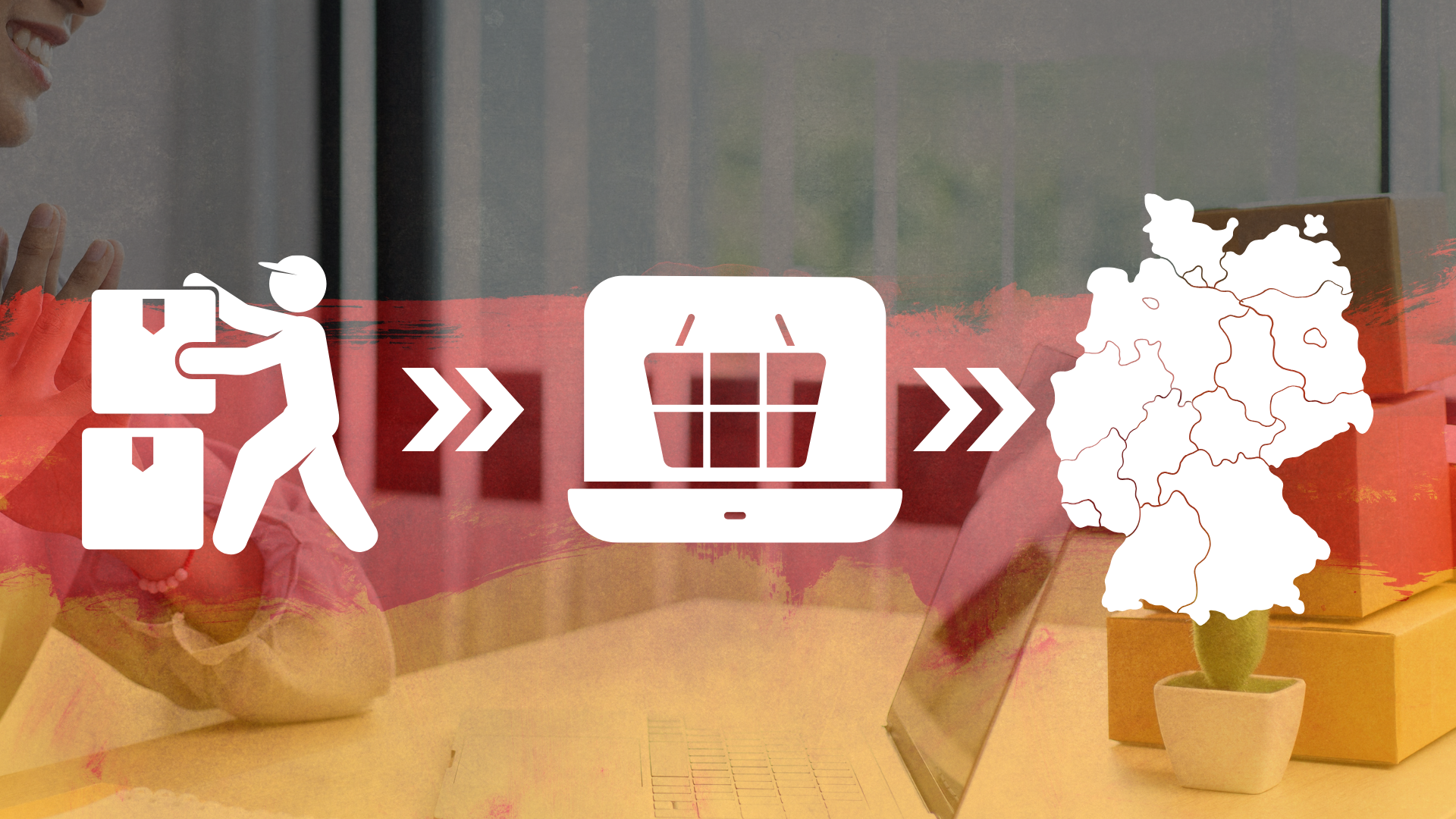 Shipping from Poland is usually enough to start with; a warehouse in Germany only makes sense at higher volumes.
Whichever model you choose, you’re bound by German consumer law, including the 14-day right of withdrawal (Widerrufsrecht). German customers love two things: order and the option to send goods back. A smooth, clear returns policy isn’t a nice extra; it’s a precondition for good reviews and for keeping your account.
Most businesses start by shipping from Poland, because it lets them test the market with minimal paperwork. A local warehouse comes into play later, once volumes start to justify the cost and next-day delivery matters to you.
How much does it cost to send a parcel to Germany?
Sending a standard parcel from Poland to Germany costs from around PLN 30–50 net through a courier broker, and it usually arrives within 2–3 working days. The price depends mainly on weight and size, because couriers charge whichever is higher: the actual weight or the volumetric weight. At higher volumes, it pays to sign a contract directly with a carrier or to ship by pallet.
Two things are worth calculating straight away. First, the cost of returns, because some parcels will come back to you and someone has to pay for that journey. Second, the free delivery threshold, which German customers treat almost as standard. Delivery isn’t just a logistics cost; it’s also part of the price, and it affects conversion.
How long does it take to enter the German market?
It usually takes 4 to 8 weeks from the decision to the first sale, and reaching stable profitability typically takes 3 to 6 months. Registering on the platform and with LUCID is a matter of days. Most of the time goes into preparing good German-language listings, setting up logistics and building visibility, because a new account starts with no history and no reviews.
Here’s a realistic timeline for launching on one platform:
Stage | Timing | What happens |
|---|---|---|
Formalities and registrations | Weeks 1–2 | Platform account, LUCID, dual system, sorting out VAT |
Preparing listings | Weeks 2–4 | Localising descriptions, photos, pricing, logistics and returns |
Sales launch | Weeks 4–6 | First orders, advertising, collecting reviews |
Optimisation and profitability | Months 3–6 | Scaling what works, improving margins |
Things can move faster when the platform and the product are a good match. A wooden products manufacturer we worked with at Raise Your Sales achieved a 12-fold increase in its Amazon sales in seven months. That’s neither magic nor a guaranteed rule, but the result of consistently optimising listings and advertising in a well-chosen market.
What are the most common mistakes Polish businesses make when selling to Germany?
The four most common and most costly mistakes are translating listings instead of localising them, ignoring VerpackG, setting prices without allowing for returns, and betting everything on a single channel. Any one of them can kill profitability before the market even has a chance to show its potential.
A word-for-word translation is obvious at a glance, and German customers don’t trust it. A listing should read as if a German wrote it, not as if it had been run through a translation tool. Ignoring VerpackG ends with a blocked account and a fine, the worst possible scenario: your product, logistics and advertising are ready, but you can’t sell.
Pricing without a buffer for returns and commission is a classic. The business is pleased with its turnover, then, once everything is deducted, it turns out it’s losing money. And finally: dependence on a single channel. With just one platform, you depend on one set of rules, and a single algorithm decision can cost you your sales. Diversification isn’t a luxury; it’s a safety net.
Selling to Germany: Summary
Entering the German market is less a leap into the unknown and more a phased project with calculable costs and predictable stages. The difficulty lies not in the size of the market or the competition, but in a handful of formalities you need to get done at the start, and in the discipline not to spread yourself across every platform at once. Businesses that bounce off Germany usually haven’t lost to the market. They’ve lost to their own lack of a plan: they treated expansion as translating a listing, not as a separate business that needs attention.
The good news is that the barrier to entry is lower than it seems from a Polish perspective. You have a good product, cheap transport to the country next door and Europe’s largest e-commerce market just across the border. Everything else is execution, and execution can be planned and repeated.
If you want to find out whether your product has potential in Germany and which platform to start with, book a free consultation with Raise Your Sales. We’ll tell you straight where we see a chance of profitable sales and where you’re better off walking away, so you don’t waste time and money on a market that simply doesn’t pay off for you.
Did you find this article helpful?
This article has no ratings yet — be the first.
Autor
Wojciech Piszczek
CEO & Founder
I’ve been immersed in e-commerce for more than ten years, with a core focus on helping brands scale onto international platforms like Amazon, eBay, Kaufland, and eMAG. My experience covers the entire sales lifecycle—from high-level strategy and logistics to marketing and conversion optimisation. I help businesses not only enter new markets but scale sustainably, ensuring they avoid the costly pitfalls often faced by those just starting out.