
 Polski
 Čeština
 Slovenčina
 Deutsch
 Italiano
 Español
Allegro ADS – A Guide to Advertising on Allegro in 2026
You sell on Allegro and you can see that simply being in the catalogue isn't enough. Competitors in your category have dozens, sometimes hundreds of similar listings, and your product gets lost somewhere on the third page of results. Shoppers simply don't see it, so they can't buy it.
 Wojciech PiszczekCEO & Founder
This is where Allegro ADS comes in: the platform's advertising system, which lets you buy yourself a higher position and more visibility instead of waiting for the algorithm to reward your listing on its own. The problem is that many sellers launch a campaign, look at the spend in the dashboard and, frankly, have no idea where that money is actually going. At RYS, where we provide Allegro ADS campaign management, we see this all the time: the budget keeps flowing, sales rise a little, but nobody can say whether that's down to the ads, the season or sheer chance. If you want to change that and know exactly how Allegro ADS works, what it costs and how to set it up wisely, this guide is for you.
What is Allegro ADS?
Allegro ADS is Allegro's advertising system, which lets sellers pay for better visibility of their listings in search results, on product pages and outside the platform itself, e.g. on Google. You don't pay for the ad simply appearing: most of the time you pay for a click on it (the CPC model) or for impressions in display formats (the CPM model).
It works as an auction. You state how much you're willing to pay per click, and the system decides in real time which listing is shown and in what order. The highest bid doesn't always win; what counts is the combination of bid and listing quality, the so-called quality score.
For a seller, it's practically the only way to get a new product with no sales history to show up in the results at all. Organic rankings take weeks to build. Advertising gives you visibility straight away – at the expense of budget rather than time, of course.
How does advertising on Allegro work?
Advertising on Allegro works like an auction decided in a split second, every time someone types a search term into the search bar. You set the maximum CPC bid you're willing to pay for a click. Allegro will never charge more than that bid, and it often charges less if the competition is weaker at that moment.
The system takes two things into account: your bid and the quality of your listing, which covers CTR, how complete the description is and how well it matches the query, among other things. A good listing with a lower bid can beat a weaker listing that bids higher. That's good news for smaller sellers, because the biggest budget doesn't always win.
You only pay for a result, i.e. a click or an impression, never simply for taking part in the auction. The daily or total budget you set is a hard limit. The campaign won't exceed it, so there's no risk of waking up to a bigger bill than you planned.
What types of Allegro ADS campaigns are there?
Allegro ADS isn't a single product but several formats with different uses and billing models. Which one you choose depends on what stage your product is at and whether you're focusing on sales or on brand awareness.
Campaign type | Where it appears | Billing model | Best for |
|---|---|---|---|
Oferty Sponsorowane (sponsored listings) | Search results, listing pages | CPC / Dynamic CPC | Most sellers, products that convert |
Display ads | Homepage, categories, side columns | CPM | Brand awareness + sales with good keyword targeting |
Allegro Ads Display outside the platform | Google, ad networks | CPC | Extra reach beyond Allegro |
Video ads | Product pages, feed | CPM | Products that need to be shown “in action” |
Most sellers start with Oferty Sponsorowane, because this format has the lowest barrier to entry and the most measurable results.
Oferty Sponsorowane – the core campaign type
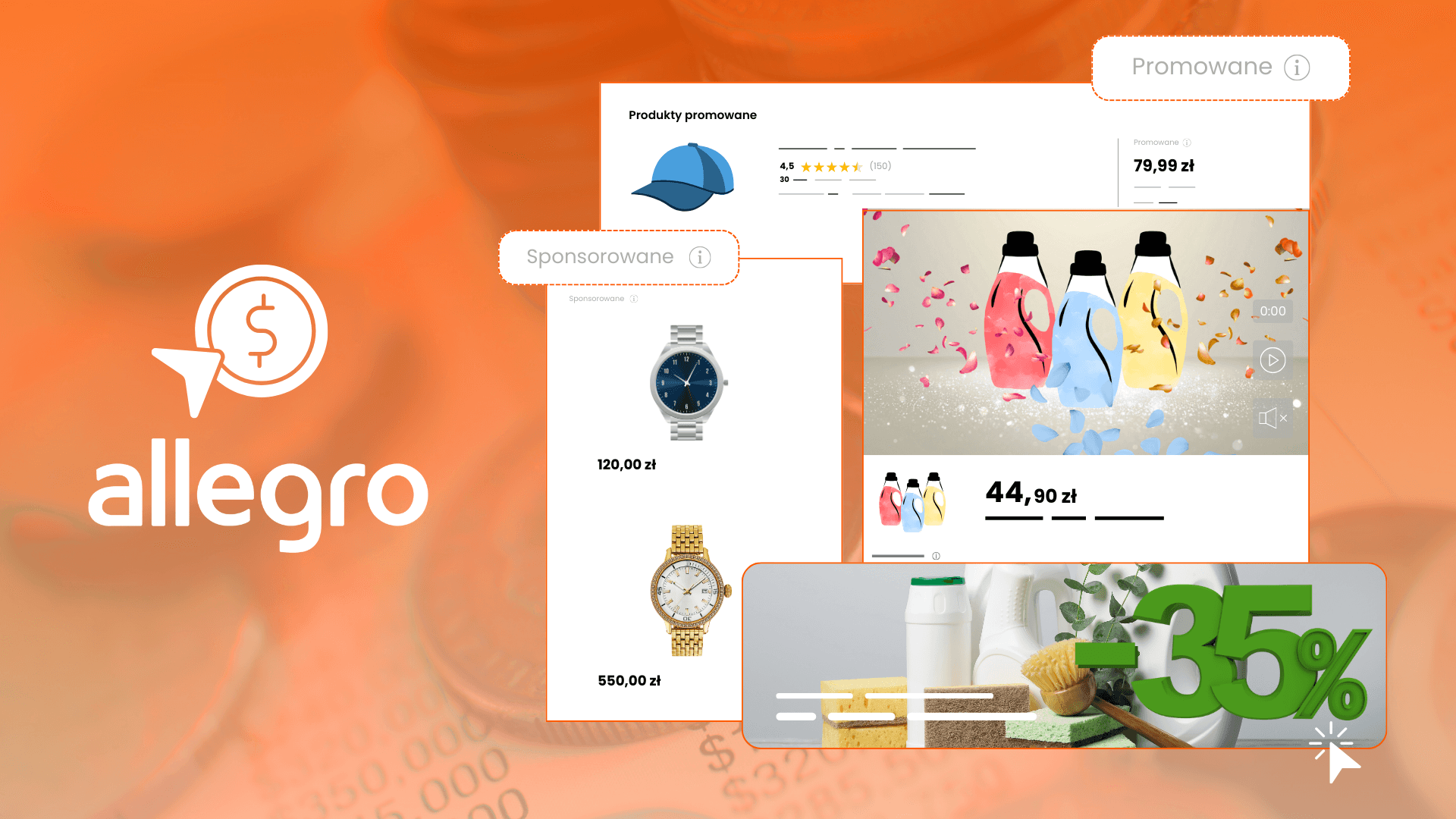
Oferty Sponsorowane is the format practically every seller on Allegro starts with. Your listing appears higher in search results and on related product pages, labelled “Sponsored”. You're billed on a CPC basis, which means you only pay when someone actually clicks.
You set up the campaign at the level of a single listing or a product group, then choose your CPC bid and daily budget. Allegro also offers Dynamic CPC, where you declare a target average cost per click and the algorithm raises or lowers the bid itself, depending on the likelihood of a sale at any given moment.
Allegro display ads – when are they worth switching on?
Allegro display ads are banners shown on the homepage, in categories and in the side columns, billed on a CPM basis, i.e. per thousand impressions. That said, this isn't a pure branding format. You target the campaign at specific keywords and negative keywords selected by the Planer kampanii (the campaign planner in Allegro Ads), so the banner can reach exactly the people typing in search terms related to your product. In practice, this brings the format closer to a sales model, rather than just building brand awareness.
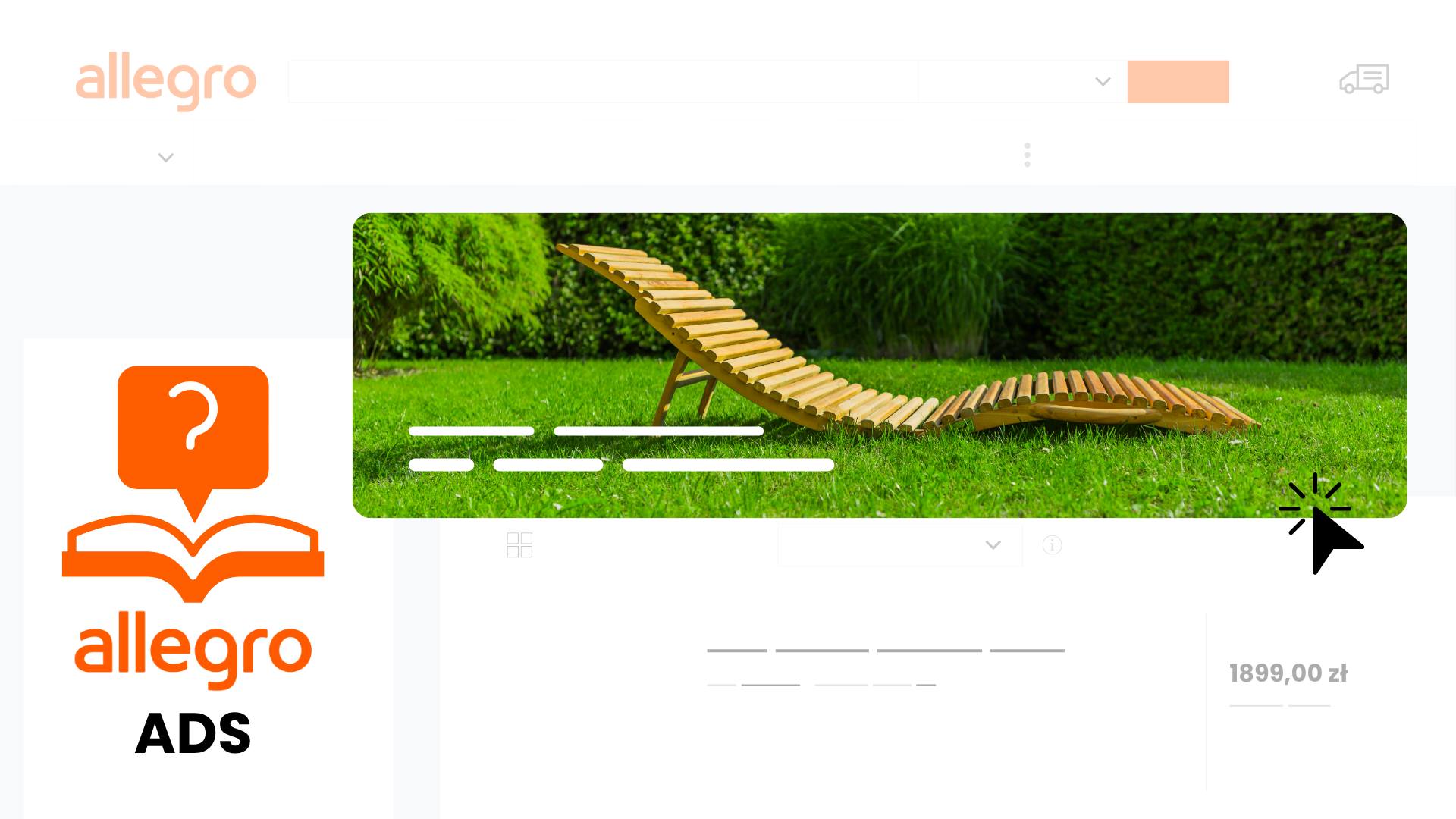 A banner billed on a CPM basis can reach people typing in search terms related to your product.
Display ads are worth switching on once you already have a CPC campaign that works and also want to reach people who are still typing in broader queries before narrowing down their search. They also work well for product launches and in peak season, when you care about both awareness and extra traffic.
The key to making them pay off is regularly downloading the search term report and adding negative keywords. Without that, display ads can easily turn into costly, poorly targeted exposure instead of a genuine sales channel.
Allegro Ads Display and other formats
Besides Oferty Sponsorowane and display ads, Allegro has extended ad delivery beyond the platform itself, including to Google and ad networks. This lets you reach customers before they even visit Allegro, not only once they're already browsing search results.
Treat off-platform and video formats as a complement, not the foundation of your strategy. They give you extra reach, but they need an already stable core campaign and a bigger budget to deliver measurable results rather than just nice-looking impression figures in the dashboard.
How do you set up an Allegro ADS campaign step by step?
Setting up your first Allegro ADS campaign takes a quarter of an hour or so, but a few decisions at the start will determine whether your budget goes in the right direction or simply melts away.
- Choose the products to promote. Start with the listings that have the best organic conversion, not the ones you most want to sell.
- Go to the Allegro Ads panel and create a new Oferty Sponsorowane campaign.
- Set a daily budget. Start cautiously, e.g. PLN 20–30 a day as a test, so you can collect data before scaling.
- Choose your CPC bid. Take the bid suggested by Allegro and start at 70–85% of that value.
- Check your CTR after a few days.
- Look at conversions, not just clicks. A high CTR with a low ROAS points to a problem with the listing, not the bid.
- Scale your budget gradually. No more than 20–30% a week.
Patience at the start pays off later in the form of more stable, cheaper clicks.
How much does advertising on Allegro ADS cost?
The cost of Allegro ADS depends mainly on the product category, how competitive it is and where the ad is shown, so there's no single universal rate. In practice, in the least competitive categories the minimum CPC bid starts at around PLN 0.10, while in highly competitive categories it can be several times higher. On top of that comes the daily budget, which you set yourself and which acts as a hard spending limit.
The real cost of advertising, however, isn't the CPC bid itself but the ratio of spend to return, i.e. ROAS calculated on margin rather than revenue. We cover budgets and specific cost ranges in more depth in a separate article devoted entirely to Allegro ADS costs, as the topic is too broad to fit into a single paragraph of this guide.
How do you optimise Allegro ADS campaigns?
Optimising Allegro ADS campaigns starts with structure, before you even look at any numbers.
- Split campaigns by product group rather than running one shared pool. Each product group is a separate campaign with its own budget and bid. That way, a bestseller doesn't “eat up” the budget of a product that's only just getting going.
- Break each product group down further by placement. Search results separately, the listing page separately, the left-hand column separately, Google Ads separately. The same products behave differently in each of these places, so lumping them into one campaign blurs precisely the differences you care about most.
- Check results daily at the start. The first days or weeks of a campaign are when a mistake costs the most, because you don't yet know what works.
- Look primarily at cost relative to sales, not at spend alone. What you want to know is whether any listing in a given group and placement is starting to burn through budget without a return.
- Quickly switch off what isn't working and move budget to where ROI is clearly higher. This campaign structure lets you do that in a few minutes, with no risk that switching off one listing will affect the others.
This split takes more work up front than one catch-all campaign, but it's exactly what gives you real control over where the money goes, instead of guesswork.
The most common mistakes in Allegro ADS campaigns
The most common mistake in Allegro ADS campaigns is promoting products that don't sell organically, in the hope that advertising will fix it. Advertising amplifies existing conversion; it doesn't create it from scratch. The second mistake is a lack of segmentation: one campaign for all products means that the bid chosen for a bestseller “drags up” costs for products that don't need it at all.
And the mistake we see most often among our clients at RYS: no clear ROAS threshold below which a campaign is simply switched off. Without that threshold, a seller keeps losing money on advertising for months because “something's selling, after all”, without working out the real profitability after margin.
Allegro ADS vs Amazon PPC – what's the difference?
Allegro ADS and Amazon PPC work on a similar auction principle, but they differ in the scale of competition and the maturity of their tools. Amazon PPC has a longer history, more advanced targeting options, including campaigns on competitors' keywords, and higher demands in terms of data analysis, because you're often competing on a global scale rather than in a single country.
Allegro ADS is simpler to implement and cheaper to start with, which makes sense, as the market is smaller and less competitive than Amazon in the US or Germany. That's good news for smaller sellers who want to test advertising without a large upfront budget.
There is, however, a common denominator we see among clients on both platforms: advertising won't fix a weak listing. Neither Allegro nor Amazon will turn a product that doesn't convert into a bestseller just because of a higher CPC bid. It's a bit like advertising a shop more loudly when nobody's going to walk in anyway if the shop window is empty.
Summary
Allegro ADS isn't a magic switch that turns sales on. It's a tool that amplifies what's already working and ruthlessly exposes what isn't. Sellers who treat advertising as a way of rescuing a weak listing end up with high spend, wondering why their budget disappears without results. Those who treat it as an amplifier for a well-prepared product gain visibility they would otherwise have to wait weeks for organically. The difference between the two approaches usually isn't the size of the budget, but whether someone regularly looks at the data and draws conclusions from it, instead of setting up a campaign once and forgetting about it.
If, after reading this guide, you're wondering whether your Allegro ADS campaigns even stand a chance of being profitable given your margin and scale, we'd be happy to look into it with you. Book a free consultation with our team: we'll analyse your account and tell you straight where you're losing budget and what's worth changing.
Did you find this article helpful?
This article has no ratings yet — be the first.
Autor
Wojciech Piszczek
CEO & Founder
I’ve been immersed in e-commerce for more than ten years, with a core focus on helping brands scale onto international platforms like Amazon, eBay, Kaufland, and eMAG. My experience covers the entire sales lifecycle—from high-level strategy and logistics to marketing and conversion optimisation. I help businesses not only enter new markets but scale sustainably, ensuring they avoid the costly pitfalls often faced by those just starting out.