
 Polski
 Čeština
 Slovenčina
 Deutsch
 Italiano
 Español
Allegro commissions and fees – understand your selling costs in 2026
Allegro commissions can feel like a minefield when expanding your e-commerce business into Central and Eastern Europe. In this guide, we break down exactly what commission rates apply across different product categories and reveal the true total cost of selling on Allegro. You will gain practical insights into listing fees, promotional packages, Allegro Smart! and Allegro Pay so you can price your products accurately and safeguard your margins.
 Wojciech PiszczekCEO & Founder
We have all been there. You look at the fee schedule, see a 12% category commission, run the numbers, and think, "Fair enough, that works for my margin." Then the end-of-month invoice lands, and that 12% has mysteriously inflated. You are suddenly looking at delivery subsidies for Allegro Smart!, surcharge fees for highlighted listings, promotional coins, and seasonal discounts.
To be direct: the platform breaks down its charges into dozens of minor line items, making it remarkably easy for merchants to lose track of their real cost per unit. Selling on Allegro can quickly feel like navigating a maze where your profits quietly slip away. This article strips back the complexity, dissecting the platform's cost structure so you can see exactly where your money goes – and how to keep hold of it.
How to calculate your Allegro sales commission
Let's start with the basics. The core sales commission is the single largest expense you will encounter on Allegro. The concept seems straightforward: you sell an item, and the platform takes a percentage cut.
However, the sting lies in how that percentage is calculated. Many merchants moving onto Allegro are caught off guard when they discover that commission is not charged solely on the item's retail price – it is calculated on the total transaction value (product price plus shipping paid by the customer).
 Allegro commission rates by category
What do the rates look like in practice?
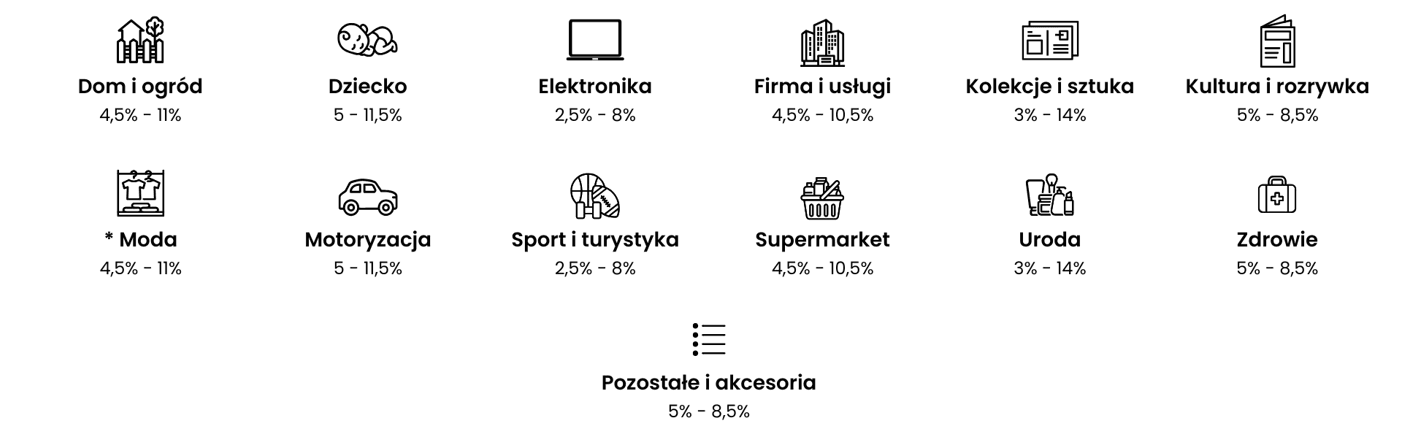
Commission rates vary significantly depending on the category you list in. Allegro reviews these fee brackets periodically, so always confirm the current rate before pricing a new SKU. Here is an overview of standard selling commission ranges across key industries, taken directly from Allegro's official fee schedule:
Category | Commission range |
|---|---|
Electronics (e.g. smartphones, laptops, headphones) | 2.5% – 8% |
Sports & Travel (e.g. bicycles, camping gear, dumbbells) | 8% – 11.5% |
Collectables & Art (e.g. antiques, coins, artwork) | 3% – 14% |
Beauty (e.g. skincare, perfumes, makeup brushes) | 8% – 10% |
Home & Garden (e.g. furniture, lawnmowers, power tools) | 4.5% – 11% |
Fashion (e.g. footwear, clothing, handbags) | Capped at 11.5% – see tiered structure below |
Business & Services (e.g. office furniture, PPE, commercial equipment) | 4.5% – 10.5% |
Supermarket (e.g. pet supplies, coffee, household cleaning) | 5% – 10.5% |
Kids & Baby (e.g. pushchairs, toys, nappies) | 5% – 11.5% |
Automotive (e.g. tyres, wiper blades, car parts) | 4.5% – 16% |
Books & Entertainment (e.g. books, board games, musical instruments) | 5% – 8.5% |
Health (e.g. dietary supplements, monitors, mobility aids) | 1% – 13% |
Accessories & Other (e.g. small gadgets, party supplies) | 13% – 17% |
Fashion is a special case worth calling out separately: it does not run on a simple percentage range like the other categories. Instead, the rate is tiered by price point – 11.5% net on the first 110 PLN of the sale price, then 7.5% net on anything above that. For a 200 PLN item, that works out to 12.65 PLN (11.5% on the first 110 PLN) plus 6.75 PLN (7.5% on the remaining 90 PLN), for a total commission of 19.40 PLN.
Notice the spread on the other categories? A seller in consumer electronics might pay as little as 2.5%, whereas a seller in Accessories & Other could face up to 17%. The trap occurs when brands set uniform prices across channels assuming an average 5% fee, only to be hit with 13% or more in their specific subcategory. That single miscalculation wipes out net profit.
Furthermore, Allegro imposes price thresholds and maximum commission caps in certain subcategories beyond the Fashion example above. Always verify your precise rate using Allegro's official fee calculator – by entering your subcategory and retail price, you will see your exact commission cost and net margin per unit.
A real-life example – watch how your margin slips away
Consider a simple scenario: you are selling an electric kettle.
- Retail price: 100 PLN
- Courier delivery charge (selected and paid by the buyer): 15 PLN
- Category commission rate: 10%
The seller's assumption: 10% of the 100 PLN item price = 10 PLN. You assume a 10 PLN fee and factor that into your margin calculations.
Allegro's actual calculation: Product price (100 PLN) + delivery fee (15 PLN) = 115 PLN total transaction value. 10% of 115 PLN = 11.50 PLN.
You are paying 1.50 PLN more per unit than anticipated. On a single sale, that seems negligible. Scale that up to 1,000 units sold in a month, and you have handed over 1,500 PLN of net profit without realising where it went. And that is before considering additional platform charges.
The cost of selling on Allegro – it is not just the commission!
The standard sales commission is merely the price of entry.
Allegro provides access to millions of active buyers across Central and Eastern Europe, but leveraging that audience comes with operational overheads. If you assume your total cost of sales is capped at the base commission percentage, your monthly reconciliation statement will come as an unpleasant surprise. Let's unpack the additional fees that build up on your account.
The cost of promoting and highlighting listings
In saturated categories, organic visibility alone is rarely enough. To stand out, sellers routinely opt for Allegro's Feature (Wyróżnienie), accepting a recurring fee of 19.90 PLN (approx. £3.85), charged every 10 days, to bump their listings up the search rankings. Lower rates of 5.90 PLN or 2.90 PLN per 10 days apply in a handful of specific subcategories (such as jewellery and children's footwear), and a Flexible Feature option is billed at 2.90 PLN per single day.
The main financial tripwire here is not the fixed 10-day charge – it is the secondary fee known as the extra commission on highlighted listings.
When a customer purchases a product from a highlighted listing, Allegro charges your standard category commission plus a surcharge on that sale. This surcharge is a flat 75% (0.75×) on top of your base category commission, applied consistently across all of Allegro's highlighting options.
The kettle example revisited:
- Kettle price: 100 PLN | Delivery: 15 PLN | Total: 115 PLN
- Base category commission (10%): 11.50 PLN
- Highlighting commission surcharge (75% of base commission): 8.63 PLN
- Total commission on the sale: 11.50 PLN + 8.63 PLN = 20.13 PLN
Instead of the expected 10 PLN fee, you are paying over 20 PLN on a single transaction – roughly doubling your cost of sale. If this surcharge is not factored into your landed cost models and consumer pricing, sales velocity will simply erode your margins.
Delivery subsidies under Allegro Smart!
Allegro Smart! is the cornerstone of consumer loyalty on the platform, offering buyers subscription-based free delivery from a minimum order value of 49.90 PLN. Shoppers heavily filter search results to show Smart!-eligible offers, and Allegro reports that Smart!-badged offers grow roughly five times faster and sell around 2.5 times better than offers without the badge. However, free delivery for the buyer is co-funded by the seller.
As a merchant, you pay a co-financing contribution for every order dispatched under the Smart! badge, and the exact amount varies by order value and delivery method. Because these figures are adjusted periodically, always check the current breakdown in your Fees Summary or Fee Calculator in Sales Center before building them into your pricing model, rather than relying on a fixed table – what looks accurate today can shift within the year.
Allegro Ads campaigns – paying for clicks, not sales!
Allegro Ads operates on two billing models: CPC (cost per click, for sponsored offers) and CPM (cost per mille, for display ads) – you pay for user clicks or ad views, regardless of whether those visits convert into orders. Minimum bids start at 0.10 PLN per click for sponsored offers and 9 PLN per 1,000 views for display ads, with minimum daily budgets of 3 PLN and 15 PLN respectively.
Determining an initial budget:
There is no one-size-fits-all figure for ad spend. For brands entering Allegro, we typically recommend an initial test budget of 2,000–3,000 PLN (approx. £400–£600) per month. The objective during the initial phase is data acquisition: discovering high-converting keywords, evaluating competitor bidding aggression, and calculating baseline acquisition costs.
Targeting the right ROAS:
ROAS (Return on Ad Spend) measures the gross revenue generated for every unit of currency spent on advertising. A "good" ROAS depends entirely on your product margins:
- A brand owner or manufacturer with a 50% gross margin has a mathematical break-even ROAS of 2.0 (200%), and can typically target a ROAS of 5.0 (500%) or higher to run a genuinely profitable, scalable campaign.
- A distributor working on a slim 10% gross margin has a mathematical break-even ROAS of 10.0 (1000%) on product margin alone – and in practice needs to aim closer to 15.0–20.0 once Allegro's own commission, Smart! contributions and other platform fees are layered on top of the base cost of goods.
Running PPC campaigns without continuous ROAS tracking relative to net margins is one of the fastest ways to burn capital on marketplace channels.
Monthly Allegro subscriptions
Allegro offers three monthly merchant subscription tiers (Abonament), all billed gross every 30 days:
- Basic Subscription (49 PLN / approx. £10 per month): Essential for professional sellers. Unlocks core features including custom store logos on listings, offer tagging, and product series grouping.
- Professional Subscription (199 PLN / approx. £40 per month): The standard choice for established merchants. Key benefit: access to Trade Analytics, Allegro's deep market research tool for tracking competitor sales volumes, average prices, and category trends. Also enables custom promotional banners on product pages.
- Expert Subscription (3,000 PLN / approx. £600 per month): Designed for high-volume enterprise brands. Allows seller branding to appear directly on search result pages next to listing titles, driving brand recall and click-through rates.
Unlike transaction commissions or Smart! delivery contributions, subscriptions are fixed overheads billed every 30 days regardless of sales volume.
Listing fees
In the vast majority of categories, listing products on Allegro is completely free of charge. Listing fees only apply to a small number of specific departments (such as certain Automotive vehicle listings, used tyres, Collectables, Antiques, and Classifieds). Where applicable, they are billed in 10-day cycles and range from a few pence to a few pounds per listing.
Additional fees – hidden margin drainers
Beyond commissions and ad campaigns, several optional promotional tools can silently erode account profitability:
- Allegro Coins (Monety): Virtual loyalty points awarded to buyers to drive conversion. Merchants fund these directly: each Coin awarded costs 1.23 PLN gross. Adding 3 Coins to an offer to incentivise buyers adds an instant 3.69 PLN direct cost to the sale.
- Deal Zone & Seasonal Campaigns (Strefa Okazji, Allegro Days, Black Week): Participating in platform-wide sales events grants badges that increase conversion rates. However, participation often carries a daily event fee plus an additional Deal Zone commission surcharge on every item sold.
- Discount Vouchers (Kupony rabatowe): Custom seller vouchers (e.g. "10 PLN off orders over 150 PLN") are effective conversion triggers, but the discount value is 100% funded from your margin.
When should your selling costs trigger a warning light?
When tracking dozens of individual line items, it is vital to review account health at a macro level. The key metric for evaluating marketplace health is your Total Cost of Sales (TCoS) ratio – calculated as total platform charges divided by total gross sales turnover (including shipping fees paid by customers).
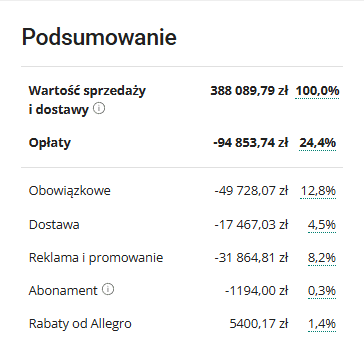 Example Allegro fee summary: total fees as a share of sales
When does it get dangerous?
As a general benchmark across marketplace channels, if your total Allegro platform fees (base commission + highlighting surcharges + Smart! contributions + PPC spend + subscriptions) consistently exceed 30% to 35% of gross turnover, your profitability model requires immediate review.
At this threshold, most brand owners and distributors struggle to retain a viable net margin. High sales volume without net profit simply means financing platform growth at your own expense.
The exception to the rule – the launch phase
There is an important caveat during initial market entry. When launching on Allegro or introducing new product lines into CEE, your cost-of-sales ratio will naturally spike during the first 3 to 6 months. Aggressive ad spend, launch promotions, and sponsored positioning are necessary investments to gain search placement and algorithm authority. A 40% initial cost ratio during launch should be treated as customer acquisition cost (CAC).
However, once organic ranking and sales history are established, your fee ratio must normalise below target thresholds. If account fees remain above 35% after the launch phase, an audit of PPC efficiency, promotion structures, and pricing strategy is critical.
Summary
Understanding Allegro's cost architecture is not about avoiding the platform – it is about operating with precision. Allegro remains the dominant e-commerce marketplace in Central and Eastern Europe, giving international merchants immediate access to millions of active buyers with high purchase intent.
Building equivalent traffic on a direct-to-consumer website in a new region requires years of SEO and heavy media spend. On Allegro, the audience is ready on day one. The key to sustainable growth lies in granular financial modelling, tailored promotional strategies, and proactive channel management.
Ready to scale your e-commerce presence across European marketplaces?
Whether you are expanding into Central and Eastern Europe via Allegro and eMAG, or optimising performance across Western European channels like Amazon, eBay, Kaufland, Bol, or Cdiscount, our specialist team at Raise Your Sales is here to support your growth.
We partner with brands to audit marketplace fee structures, optimise PPC campaigns, and build profitable cross-border expansion strategies.
Book a free strategic consultation with our marketplace experts today.
Did you find this article helpful?
This article has no ratings yet — be the first.
Autor
Wojciech Piszczek
CEO & Founder
I’ve been immersed in e-commerce for more than ten years, with a core focus on helping brands scale onto international platforms like Amazon, eBay, Kaufland, and eMAG. My experience covers the entire sales lifecycle—from high-level strategy and logistics to marketing and conversion optimisation. I help businesses not only enter new markets but scale sustainably, ensuring they avoid the costly pitfalls often faced by those just starting out.