
 Polski
 Čeština
 Slovenčina
 Deutsch
 Italiano
 Español
Amazon shipping demystified: From choosing a fulfillment model to your first FBA delivery
Efficient logistics is the backbone of any successful Amazon business, directly influencing both your profit margins and customer satisfaction scores. However, navigating the platform’s diverse delivery options – and understanding how to successfully send your first batch of stock to a fulfillment centre – can feel overwhelming. This comprehensive guide breaks down Amazon’s shipping ecosystem to h
 Aneta PiechotaE-commerce Sales Expert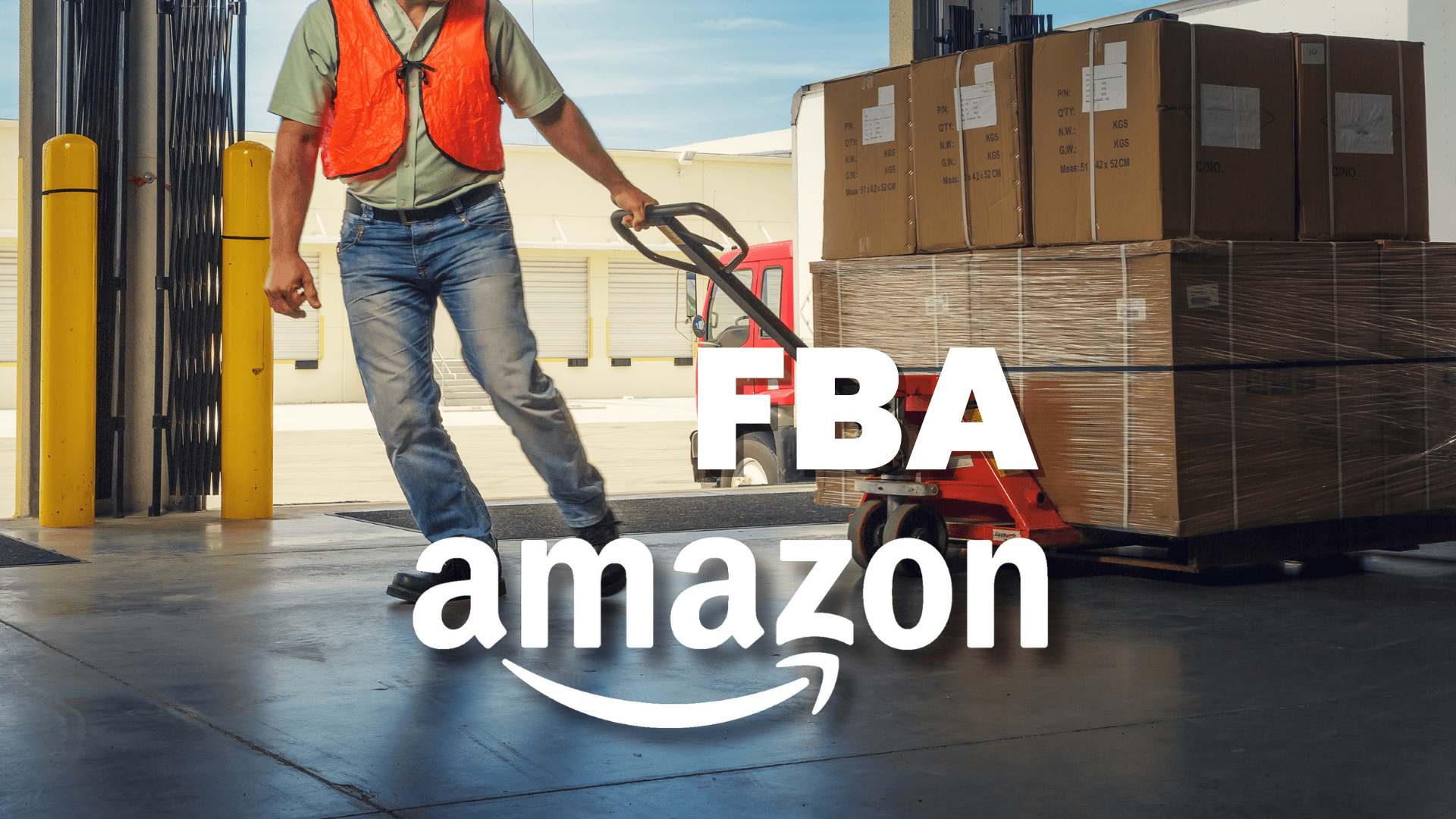
Drawing from our experience managing e-commerce expansion, we consistently see that a seller’s initial logistical strategy sets the tone for their entire marketplace journey. This is the precise stage where many brands make critical mistakes, resulting in unexpected customs delays, warehouse rejections, or early negative reviews that damage their visibility. By carefully planning your logistics from day one – balancing Fulfilment by Amazon (FBA) against Fulfilment by Merchant (FBM) and capitalising on free delivery incentives – you build a resilient foundation for long-term international success.
In this article, we will break down the essentials of Amazon logistics to help you identify the most profitable strategy for your business. We will explore how to manage local dispatches efficiently, scale up with international shipping models to tap into global markets, and leverage free shipping as a powerful conversion tool. Finally, we will walk you through a step-by-step guide to executing your very first inbound stock delivery without a hitch.
Understanding Amazon’s customer delivery options
Amazon offers buyers a wide array of delivery methods designed to meet different expectations regarding speed and convenience. Both retail consumers and business buyers can choose from options that vary by transit time, cost, and collection preference. Here are the most popular delivery types on the platform:
- Standard delivery: Usually free for orders over a specific spending threshold, with delivery times typically ranging from 3 to 5 working days.
- Priority delivery: A faster premium option, usually arriving within 1 to 2 working days from the order date, available for an additional fee.
- Prime delivery: Exclusive to Amazon Prime members, offering free express or next-day delivery at no extra cost.
- Scheduled delivery: Allows the customer to select a specific date and time slot for their delivery for an additional fee.
- Collection points: The option to pick up parcels at a chosen location (such as parcel lockers or local partner shops), which is often cheaper or more convenient than a home courier.
- Bulk delivery (Amazon Business): Tailored specifically for B2B clients, enabling large-scale wholesale orders with dedicated logistics and specialised delivery timelines.
Going international: How to ship your products cross-border
When expanding your sales across Europe, your international logistics strategy will depend heavily on your business scale, resources, and growth plans. You can choose between two primary fulfillment models:
1. Fulfilment by Amazon (FBA)
With this model, you ship your inventory in bulk to Amazon’s fulfillment centres (either locally or within the EU). Amazon then takes complete control of storing, picking, packing, shipping, and handling customer returns.
Under FBA, your goods are stored directly in Amazon warehouses, allowing Amazon to handle the entire last-mile delivery smoothly. You can opt for the European Fulfilment Network (EFN), where you store stock in one country to fulfill orders across the EU, or leverage Pan-European FBA. With Pan-EU, Amazon automatically distributes your inventory across various European warehouses to speed up local delivery times – though keep in mind this triggers VAT registration requirements in those specific countries.
For brands looking to scale even further, the FBA Export programme allows you to sell to global customers outside the EU without complex international shipping logistics; Amazon takes care of the cross-border dispatch and customs formalities automatically.
2. Fulfilment by Merchant (FBM)
With the FBM model, you retain complete control over the entire order fulfillment process – from warehousing and picking to packing and dispatching orders, including international shipments. This means you carry full responsibility for delivery times, packaging quality, and handling any returns or customer complaints.
Sellers can negotiate their own contracts with domestic and international couriers. This allows you to tailor your shipping rates to specific target markets and maintain tighter control over your supply chain. You can also integrate your own logistics setup with third-party tools like ERP systems, order management platforms, and automated label-printing software.
When selling internationally via FBM, transparency is vital. You must provide crystal-clear delivery terms (including costs, transit times, and return policies) and ensure all customs documentation is perfectly filled out for shipments heading outside the European Union.
💡 Tax Note: Don’t forget that international shipping also brings tax obligations, such as VAT registration in countries where you store stock (under Pan-EU) and accurate cross-border invoicing.
Preparing for your first Amazon shipment
Getting your first shipment off the ground requires a few essential steps. Once your seller account is active and your product listings are live, you need to lock in your shipping method. If you choose FBA, you will send your goods to Amazon’s fulfillment centres for them to store, pack, and ship. If you choose FBM, you will manage everything in-house, storing products in your own facility and shipping directly to the end consumer.
For FBA, once you add your products to the Amazon system, you will receive clear shipping instructions, item labels, and the address of the specific fulfillment centre assigned to your inventory. It is absolutely vital to pack your products strictly according to Amazon’s guidelines to avoid costly delays or warehouse rejections. Once your stock arrives safely at the warehouse, Amazon takes over the heavy lifting.
If FBM is your choice, you must organize the logistics yourself, ensuring you have the right packaging materials, reliable courier services, and end-to-end parcel tracking. In this scenario, you are on the hook for the entire delivery performance and customer support.
Step-by-step guide: How to send your first inbound shipment to Amazon FBA
Before launching the workflow in Seller Central, make sure you have gathered your exact shipment data:
- SKU details
- Total number of units being shipped
- Outer box dimensions and total weight
- Box content details (knowing exactly which item is in which box)
Expert Tip: If you do not hold a German VAT registration yet but want to target consumers on Amazon.de, you can prepare and send your shipment from your local European dashboard, provided the listings are created there and converted to FBA.
Step 1: Navigate to Send to Amazon
Log into Seller Central, go to Manage FBA Shipments, and click on the Send to Amazon tab.
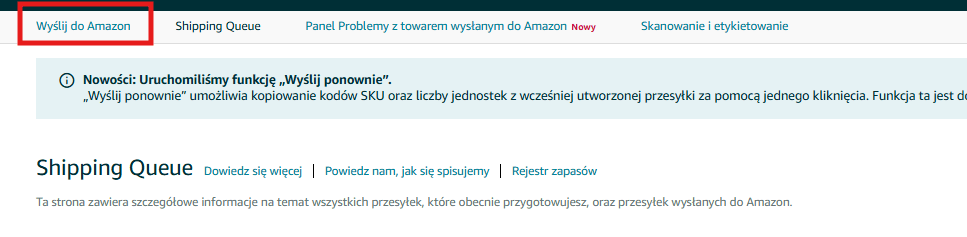
Send to Amazon
Step 2: Provide packing details
Search for your specific SKUs in the list. Under the Packing details column, select or create a template, and choose the required prep category based on your product type (e.g., Fragile/Glass, Liquids (non-glass containers), or No prep needed) from the drop-down menu.
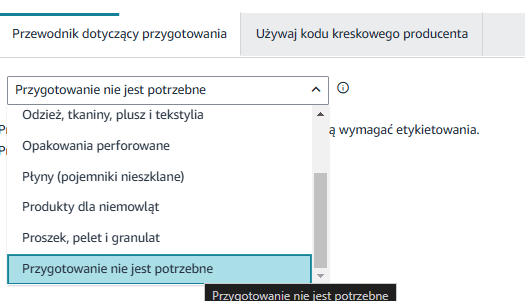
Provide packing details
Step 3: Enter quantities
Enter the number of units or cases for each product and click Ready to pack.
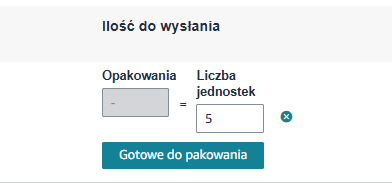
Enter quantities
Step 4: Pack individual units
Once the quantities for all your SKUs are locked in and marked as ready, click the Pack individual units button at the bottom of the page.
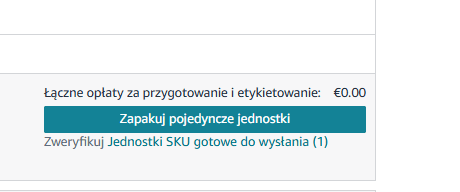
Pack individual units
Step 5: Choose box configuration
In the box content information section, specify whether your shipment is split into multiple boxes or if everything fits into a single box (Everything in one box or Multiple boxes needed), then confirm your choice.
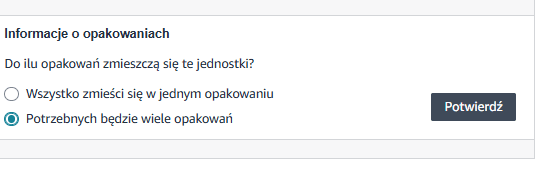
Choose box configuration
Step 6: Define box count
If your inventory requires multiple boxes, open the web form provided by Amazon and enter the total number of boxes included in the delivery.
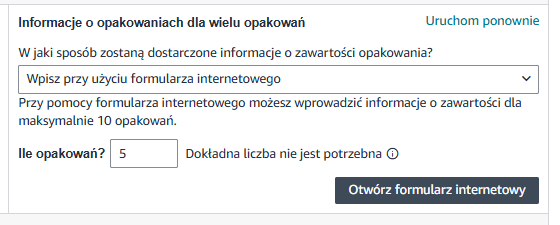
Box count
Step 7: Fill in box contents
Your listed products will appear with fields to allocate them to specific boxes (for instance, if your delivery contains 5 boxes, fill in the quantities for each box according to your physical packing list). Finally, enter the exact dimensions and weight for each box and click Confirm box information.
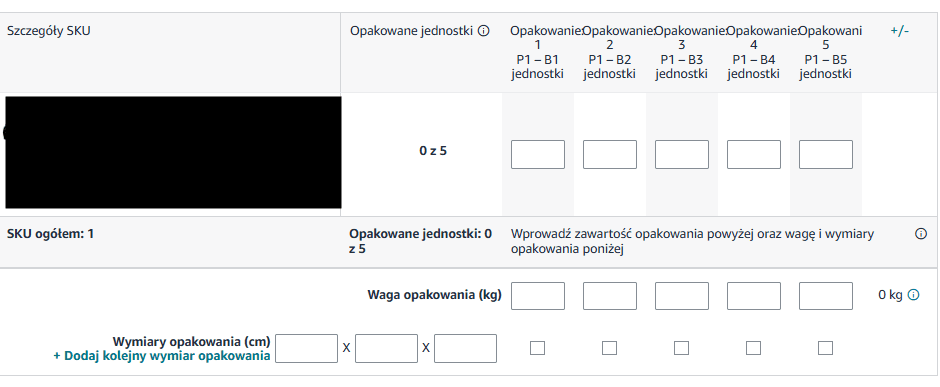
Box contents
Step 8: Confirm shipment
Double-check everything to ensure total accuracy, then approve the shipment and accept the estimated fulfillment fees.
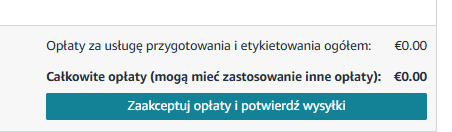
Confirm shipment
Step 9: Select shipping mode and date
Select whether you are shipping individual boxes (Small Parcel Delivery – SPD) or a pallet (Less Than Truckload – LTL), and select your shipping date. If you aren’t using an Amazon Partnered Carrier, select Other and confirm the shipment.
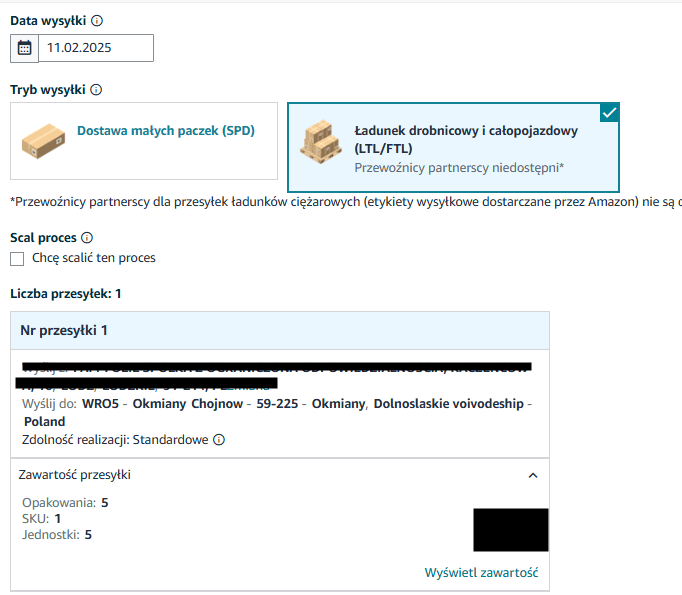
Shipping mode and date
Step 10: Print box labels
Once confirmed, a window will pop up with your generated labels. Click Print, download the labels, and stick them clearly onto the corresponding boxes based on your shipment data.
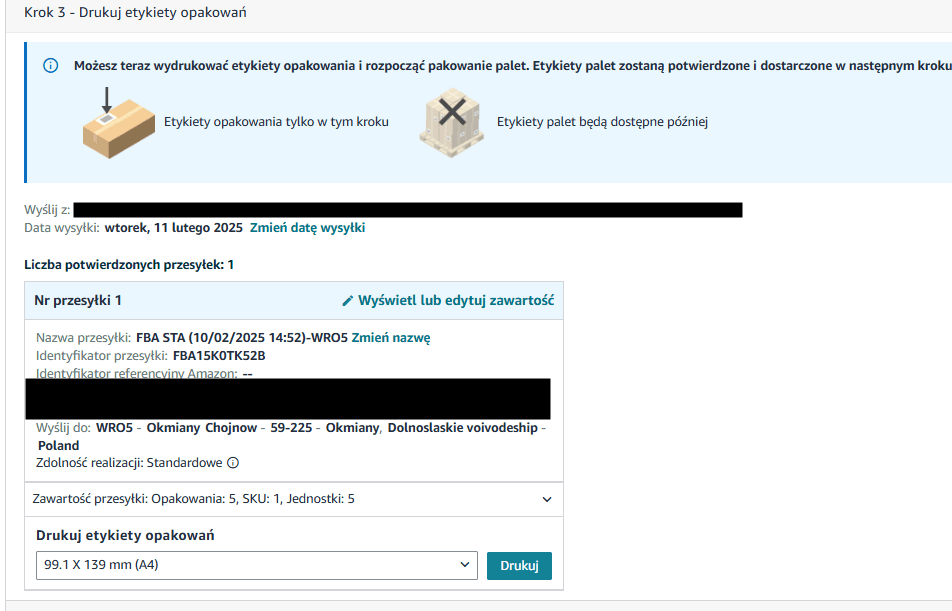
Print box labels
Step 11: Print pallet labels (if applicable)
If you are sending a pallet shipment, download the pallet labels and paste them onto all four sides of the pallet wrapper, again clicking Print.
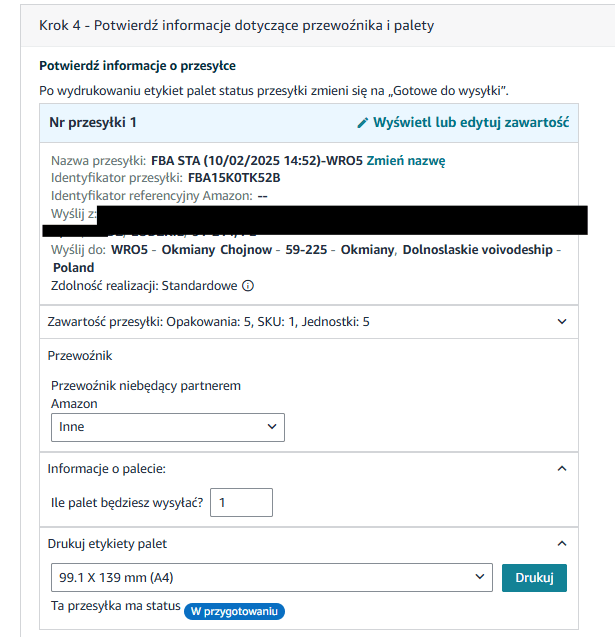
Print pallet labels
Step 12: Add tracking details
Finally, click Proceed to tracking details and enter the tracking numbers or PRO numbers for the shipment so Amazon can monitor its arrival.
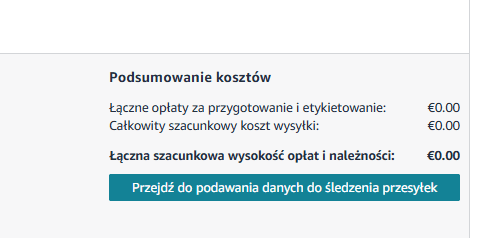
Tracking details
Crucial FBA shipping rules to remember:
To avoid having your shipment rejected at the warehouse dock, strictly adhere to these Amazon guidelines:
- The total height of the pallet, including the goods, must not exceed 180 cm.
- Pallets must be secured using only transparent stretch wrap. All products must be shipped on standard Euro or CHEP pallets (800 x 1200 mm) – other pallet types are completely barred.
- Every individual product must feature a scannable barcode label (EAN or FNSKU) covering any existing retail barcodes.
- For individual boxes, no side may exceed 63.5 cm, and the maximum weight for a single box is 22.5 kg.
- Any box or product weighing over 15 kg must be clearly marked with a “Heavy Package” label on all four sides.
Leveraging free shipping to boost sales
Offering free shipping on Amazon is an incredibly effective strategy to win over customers and make your listings stand out. For sellers, this means choosing the right logistical setup to offer free delivery while maintaining a healthy profit margin.
Sellers who opt for the FBA programme automatically make their products eligible for Amazon Prime free delivery. In this setup, Amazon manages the heavy lifting – handling storage, packing, and shipping. This instantly makes your offers more enticing to buyers, rewarding your brand with better visibility and higher search result rankings (improving your chances of winning the Buy Box).
Alternatively, you can offer free shipping via FBM without enrolling in Prime programmes. Sellers often build the shipping cost directly into the product’s retail price – a highly effective psychological trigger that drives conversions. While this impacts your gross margin per item, the jump in sales volume frequently offsets the cost. Offering free delivery is a cornerstone of a competitive Amazon strategy, but it requires sharp cost management and a rock-solid logistics partner.
Summary
A well-thought-out logistics strategy is the absolute foundation of your success on Amazon. Whether you are dispatching stock from the CEE region or managing local European hubs, choosing the right fulfillment method is vital for cutting operational costs and keeping delivery times tight. Mastering these options, including how to structure free shipping, will heavily boost your store’s competitiveness and elevate the overall customer experience.
Navigating Amazon logistics requires meticulous planning and a deep understanding of platform policies. Sellers must ensure flawless packaging and labelling, while strictly adhering to international transport regulations – especially when scaling cross-border. It is equally important to account for customs clearance, which can directly affect delivery times and add unexpected expenses if handled incorrectly. Staying ahead of these details guarantees smooth operations and prevents costly delays.
If you want to optimise your Amazon shipping processes, safeguard your Account Health, and scale your marketplace sales across Europe, book a free consultation with us today. Let’s streamline your logistics, handle your marketplace integration, and take your e-commerce business to the next level!
Did you find this article helpful?
Average rating 5.0 / 5 — 1 vote
Autor
Aneta Piechota
E-commerce Sales Expert
I’m a marketing and e-commerce enthusiast with over four years of marketplace experience. I specialise in the Amazon ecosystem, particularly in high-performance advertising. During my career, I’ve also worked with Allegro, where I scaled sales for a private-label brand. I hold a degree in Logistics Engineering, and outside of the office, I practice yoga and have a keen interest in psychology, which helps me understand the “why” behind consumer behaviour.