
 Polski
 Čeština
 Slovenčina
 Deutsch
 Italiano
 Español
What is Amazon PPC: How to advertise on Amazon?
In this article, you’ll discover how to leverage Amazon Ads effectively, why investing in the platform is a must, and how to optimise your Amazon PPC budget to supercharge your product visibility and drive more sales. We’ll also break down the best practices for Amazon advertising, demystify the key metrics, and show you exactly how to use this data to stand out in a fiercely competitive e-commerc
 Aneta PiechotaE-commerce Sales Expert
Setting up Amazon Ads might seem like a straightforward task on the surface – you simply choose your ad type, set a budget and your bids, add a few keywords, and you’re off. But what comes next? How do you effectively structure your campaigns? Should you promote your entire inventory? How do you calculate the right budget, and which metrics actually matter? Are your chosen bids even competitive? These questions constantly weigh on the minds of sellers, particularly those just starting out with Amazon advertising.
Before diving into the deep end, it’s vital to answer these core questions to avoid blowing through your ad spend and to ensure your campaigns deliver long-term profitability. A meticulously planned strategy will not only expand your reach but, more importantly, yield sustainable, profitable results. At the end of the day, advertising is the primary growth engine for your Amazon sales, directly influencing your product visibility and search rankings – including organic ones.
What is Amazon Advertising?
Amazon Ads is the proprietary advertising platform that allows sellers to promote their products directly on the world’s largest e-commerce marketplace. These ads enable sellers and brands to intercept potential customers at highly strategic moments – right when they are browsing and searching for products similar to what you offer.
Unlike other advertising networks such as Google or Facebook, Amazon Ads are inherently tied to user purchase intent. People visiting Amazon are usually there with their wallets out, ready to buy. Therefore, your ads are served to an audience that is already at the very bottom of the sales funnel.
Jeff I. Richards once said: “Creativity without strategy is called art. Creativity with strategy is called advertising.” When it comes to Amazon, it essentially boils down to pairing eye-catching, engaging content with savvy algorithm optimisation. The secret to success isn’t just making your listings look good; they have to sell. Every element of your campaign, from your product imagery to your copy, is engineered to grab attention and drive conversions. Ultimately, a good ad shouldn’t just look the part – it needs to deliver concrete results.
Why should you use Amazon Ads?
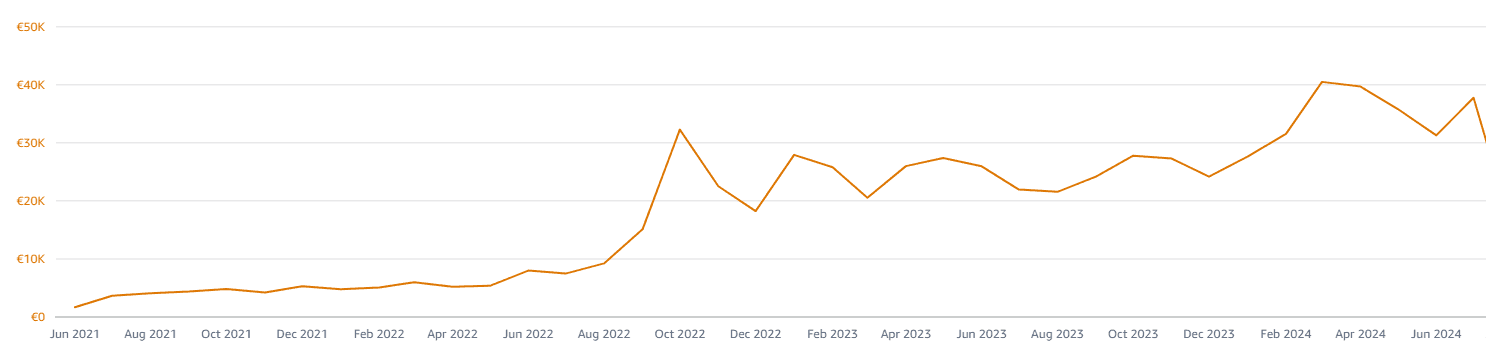
Many sellers shy away from Amazon advertising due to the upfront costs, which is a massive oversight – especially for newly launched products. Yes, running a campaign requires an initial investment, but when configured correctly with the right keywords, it will deliver a healthy return on investment (ROI) and drastically accelerate your sales velocity.
Here is why you need to start leveraging Amazon Ads:
- Help customers find your products: It can take a considerable amount of time for new listings to climb the organic rankings. Advertising allows you to generate sales immediately, bypassing the waiting game.
- Boost your revenue: More eyes on your listings inevitably leads to more sales. While ad spend does eat into your margins slightly, the sheer volume of incremental sales you wouldn’t have otherwise captured makes it highly lucrative.
- Improve your organic rankings: Sales velocity is the most heavily weighted factor in Amazon’s search algorithm. Ads drive sales, which in turn signals to the algorithm that your product is popular, pushing your organic rank higher.
What is Amazon Advertising?
Types of Amazon ads
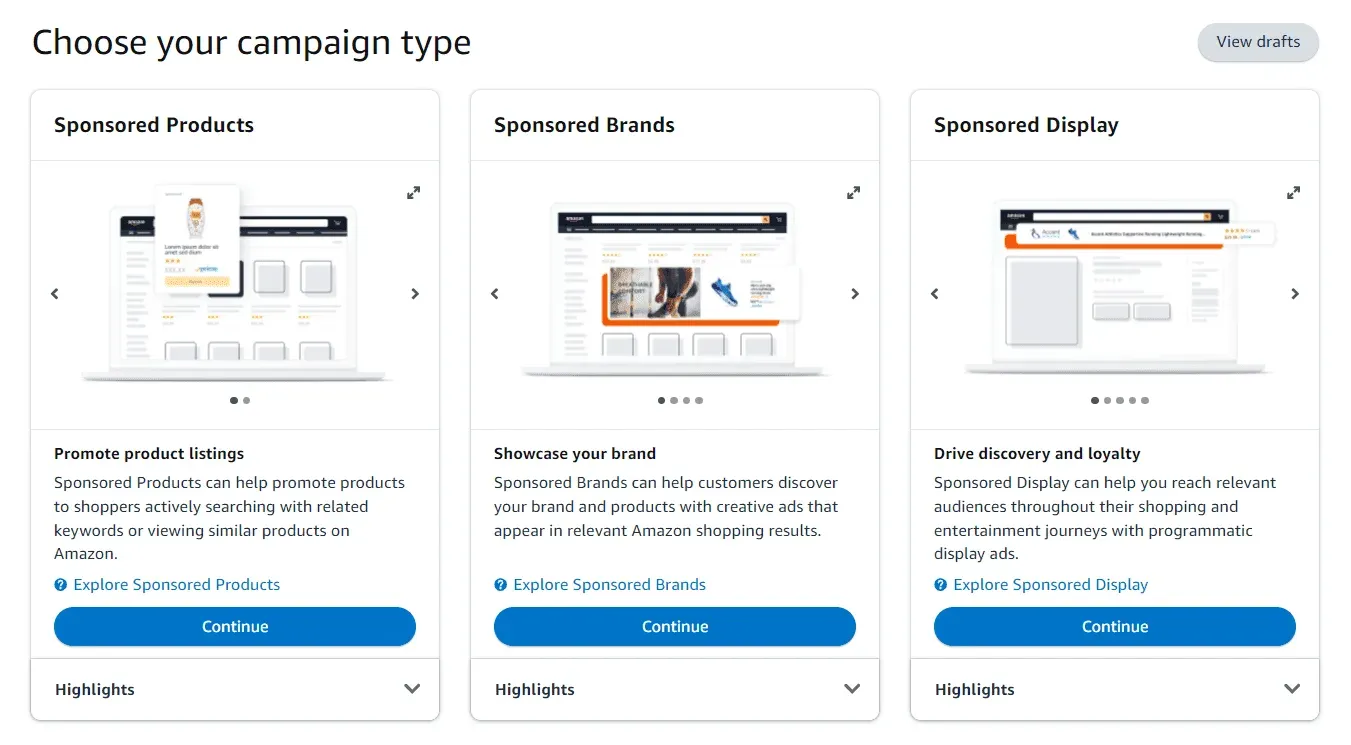
Amazon offers a suite of different ad types, namely Sponsored Products, Sponsored Brands, and Sponsored Display, giving sellers various ways to promote their inventory across the platform. These ad formats help you boost product visibility, build brand awareness, and retarget shoppers both on and off Amazon.
Sponsored Products ads
Sponsored Products ads
Sponsored Products operate very similarly to standard Google search ads. You select the ASINs you wish to promote and then target specific keywords, competing products, or categories. These operate on a Cost-Per-Click (CPC) model, meaning you only pay when a shopper actually clicks on your ad. Your listings will appear prominently on the search results page when a buyer types in one of your target keywords or browses related items.
You can leverage Sponsored Products to:
- Kickstart sales for newly launched items.
- Dominate top-of-search placements for high-converting keywords.
- Steal market share by targeting competitors’ listings.
A surge in sales driven by Sponsored Products will directly benefit your organic positioning. Greater visibility leads to more impressions, clicks, and conversions. This creates the famous Amazon “flywheel effect” – where paid sales boost organic rank, which subsequently drives even more visibility and sales.
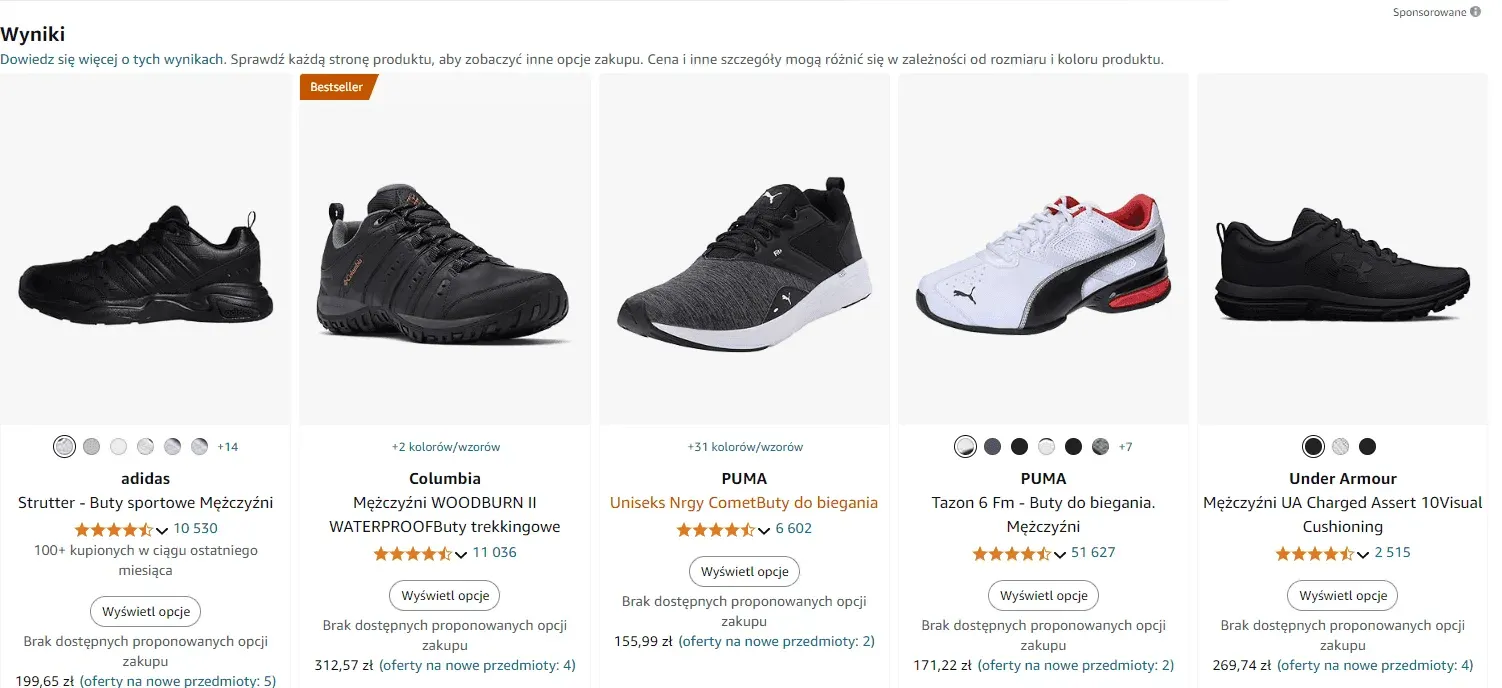
Sponsored Products ads
Sponsored Brands ads
Pushing individual products is crucial, but building and maintaining brand awareness is equally important. This is where Sponsored Brands step in. These ads allow you to showcase your brand’s unique identity, appearing as highly visible banner placements at the top of, alongside, or below search results.
Sponsored Brands allow you to direct traffic either to a custom Amazon Storefront or a dedicated landing page. The standard format features a custom headline, your brand logo, and up to three hero products, all seamlessly linking back to their respective product detail pages.
Within the Sponsored Brands ecosystem, you can also utilise Video Ads. This is an incredibly engaging format that plays automatically within the search results. They are fully clickable, taking shoppers straight to the product page and significantly boosting your chances of conversion.
The benefits of Sponsored Brands:
- Greater creative control, allowing you to align the ad with your brand’s aesthetic.
- Access to video formats, which are proven to drive higher conversion rates.
- Building trust, authority, and brand recall among existing and prospective customers.
- The ability to target loyal customers of rival brands when they search for competitor brand names.
Note: To run Sponsored Brands campaigns, you must have an active Professional Seller account. While being enrolled in the Amazon Brand Registry is no longer strictly mandatory for certain formats, it is still highly recommended to unlock the full suite of branding tools.
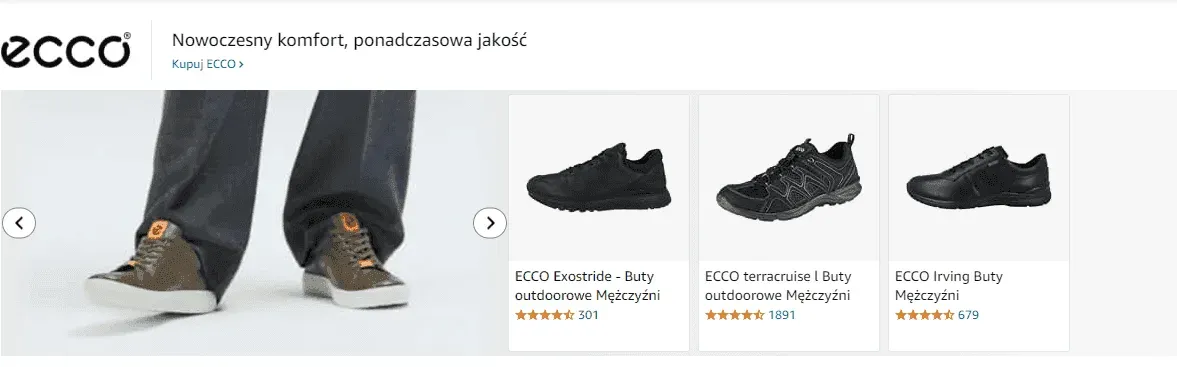
Sponsored Brands ads
Sponsored Display ads
Sponsored Display is an incredibly powerful format that lets you reach relevant audiences both on and off the Amazon marketplace. It allows you to target shoppers based on their actual buying behaviours – for instance, users who recently viewed your product page but didn’t convert, making it an excellent retargeting tool.
Through Sponsored Display, sellers can serve ads on Amazon product detail pages, as well as across third-party partner websites and apps, keeping your products top-of-mind wherever the customer goes.
The benefits of Amazon Sponsored Display:
- Re-engages high-intent shoppers who viewed your listing without purchasing, helping to close the sale.
- Expands your campaign reach beyond the Amazon ecosystem to external partner sites.
- Reinforces brand recall and cements your product’s position through multi-channel visibility.
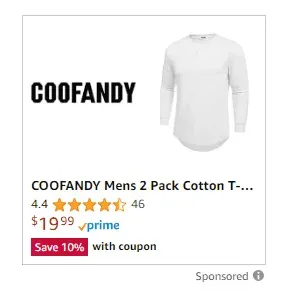
Sponsored Display ads
What does the acronym PPC mean?
PPC stands for Pay-Per-Click. In the context of Amazon Ads, PPC is an advertising model where the seller pays a fee every time one of their ads is clicked, rather than paying for mere impressions (views). Amazon’s core ad types (Sponsored Products and Sponsored Brands) run on this model, appearing in search results or on product detail pages. The beauty of PPC is that you only part with your hard-earned cash when a shopper shows genuine interest by clicking through to your listing or storefront.
Ads and organic ranking on Amazon
Your paid advertising efforts on Amazon have a direct and profound impact on your organic search rankings. When you invest in PPC campaigns, your products gain immediate visibility, resulting in an influx of clicks and, crucially, sales. This sends a powerful, positive signal to Amazon’s algorithm, which relies heavily on product popularity and conversion rates to determine search placement.
The more sales you generate through paid channels, the more Amazon views your product as highly relevant and desirable to shoppers, naturally bumping up your organic position. The higher your organic rank, the more “free” traffic you generate.
It’s a mutually reinforcing cycle: ads drive initial sales, those sales boost organic visibility, and that visibility drives even more organic revenue. Therefore, a well-rounded strategy that marries PPC with rigorous organic listing optimisation is the ultimate blueprint for long-term dominance on Amazon.
Ad campaign structure – what you need to know
When building out your ad campaigns, categorising your products correctly is vital. Unlike Google, Amazon requires a slightly different strategic approach. The golden rule is to segment your campaigns by specific products or product lines. You should ideally create a dedicated campaign for each product, encompassing all its variations (child ASINs), depending on the size of your catalogue.
For example, if you sell jeans, you would build one campaign exclusively for men’s jeans (grouping together all sizes, colours, and fits). You would then create a separate, parallel campaign for women’s jeans, again housing all the relevant variations. Your ad targeting should be broad enough to capture traffic but precise enough to prevent your own products from cannibalising each other. Crucially, ensure your targeted keywords perfectly align with your product page copy – this relevance is key to securing top ad placements.
Amazon advertising – how to set your budget
Establishing a sensible budget – both your maximum Cost-Per-Click bids and your daily limits – is a delicate balancing act. While Amazon Ads are highly effective, they directly impact your profit margins. You need to find the “sweet spot”: bids that are competitive enough to win premium placements, but low enough that you remain profitable on every unit sold.
Your ultimate goal is to reach a point where the campaign yields significantly more profit than it costs, though finding this equilibrium takes time and testing. Start with a daily budget you are comfortable with and tweak it as the data rolls in. Once your ads start delivering a healthy ROI, you can confidently scale up your spend to maximise the campaign’s overall effectiveness.
How to define your advertising goals on Amazon
Before you spend a single penny, you need to define exactly what you want your Amazon advertising to achieve. Are you chasing immediate sales volume, looking to boost listing visibility, or trying to establish brand presence?
- Increasing sales: If bottom-line revenue is your primary focus, your campaigns must target high-intent shoppers ready to buy. Precision targeting is essential here-putting your products in front of users actively searching for exactly what you sell. Sponsored Products are your best bet for this, as they intercept shoppers right at the point of search. Coupling these ads with lightning deals or coupons can further expedite the purchasing decision.
- Improving visibility: If your goal is to gain market share and get more eyes on your listings, you should focus on maximising exposure. Your ads need to appear not just in search results, but heavily across competitors’ product pages. Sponsored Display is fantastic for this, allowing you to highlight your brand and actively poach traffic. When visibility is the goal, tracking metrics like impressions and overall reach becomes paramount.
- Building brand awareness: If you’re playing the long game and want to cement your brand in the minds of consumers, focus on formats that tell a story and foster loyalty. Sponsored Brands and Video Ads are incredibly powerful tools for showcasing your brand’s unique value proposition in an engaging, premium format.
Once your core objective is locked in, select the Key Performance Indicators (KPIs) that align with it – whether that’s clicks, CPC, or ROAS (Return on Ad Spend). Monitoring these metrics ensures you can pivot your strategy on the fly, keeping your campaigns perfectly tuned to Amazon’s dynamic marketplace.
Amazon Ads – practical tips
- Keep a close eye on your campaigns: Check in regularly. If your ad spend is spiralling or your ACoS (Advertising Cost of Sales) exceeds your profit margin, incrementally dial back your bids every week or two. Conversely, if your spend is too low and your ACoS is highly profitable (e.g., under 30%), consider gradually increasing your bids to capture more volume.
- Use suggested bids wisely: Treat Amazon’s suggested bids as a baseline to gauge market competitiveness, and keep track of your actual average CPC for each keyword. You might experience higher initial costs than anticipated, but after a few weeks of data collection, you’ll be able to make informed, data-driven decisions to optimise those bids down.
- Mine your Search Term Reports: When running Auto-targeting campaigns, regularly check the Search Terms tab. Identify the exact customer search queries that are converting well. You can then harvest these high-performing terms and add them to your Manual campaigns to scale them aggressively. Similarly, take note of competitor ASINs where your ads convert – these are perfect targets for your Product Targeting campaigns.
- Aggressively use negative keywords: Your ads will inevitably trigger for broad, irrelevant terms that don’t match your actual product. By proactively using negative keywords – telling Amazon exactly which terms you do not want to bid on – you cut out wasted impressions. This instantly trims your wasted ad spend while boosting your Click-Through Rate (CTR) and conversion metrics.
Amazon Ads glossary – metrics and terms
- ACoS (Advertising Cost of Sales): The percentage of attributed sales spent on advertising. It is calculated by dividing total ad spend by total ad revenue. A lower ACoS indicates a more profitable campaign.
- ROAS (Return on Ad Spend): The inverse of ACoS. It measures how much revenue you generate for every pound invested in advertising. A higher ROAS means a better return on your investment.
- Clicks: Recorded every time a shopper clicks on your ad. Amazon provides total click data at the campaign, ad group, and targeting level.
- CTR (Click-Through Rate): The percentage of shoppers who clicked on your ad after seeing it. Calculated by dividing clicks by impressions. A high CTR indicates a highly relevant, engaging ad.
- CPC (Cost Per Click): The actual fee you pay for a single click on your ad. Under Amazon’s PPC model, this is the core cost mechanism.
- Impressions: The number of times your ad was displayed on a page. High impressions indicate strong campaign reach.
- Spend: The total monetary amount you have invested in a specific Amazon Ads campaign.
- Sales: The total revenue directly attributed to your Amazon advertising efforts.
- Orders: The total number of purchases made by shoppers after clicking on your ads.
- Conversion Rate: The percentage of ad clicks that resulted in a completed purchase. This is arguably the most critical metric for judging ad effectiveness.
- TACoS (Total Advertising Cost of Sales): Measures your total ad spend relative to your total revenue (both organic and paid). It is the best metric for assessing how advertising impacts your overall account health and profitability.
- vCPM (Viewable Cost Per Mille): The cost per one thousand viewable impressions. You pay this fee for every 1,000 times your Sponsored Display ad is actually seen by shoppers.
- Negative keywords / Negative products: Negative keywords are terms that prevent your ad from showing when a customer searches for them, saving you from useless clicks. Negative products allow you to exclude specific competitor ASINs, ensuring your ad doesn’t show up on irrelevant product pages.
- Automatic campaign (Auto-targeting): A campaign type where Amazon’s algorithm automatically determines keyword and product targeting based on your listing’s data and shopper behaviour.
- Manual campaign: A campaign where you retain full control over targeting and bids. It requires regular monitoring and manual adjustments but offers maximum precision over your budget.
Summary
Amazon Ads is a formidable tool for sellers, drastically boosting product visibility on one of the world’s most competitive e-commerce platforms. With a diverse toolkit featuring Sponsored Products, Sponsored Brands, and Sponsored Display, you can intercept shoppers at the exact moment they are ready to buy.
It’s a fascinating ecosystem – it demands rigorous analysis and a sharp strategy, but the payoff when you see tangible results is incredibly rewarding. It’s a bit like putting together a jigsaw puzzle: every single piece, from your budget limits to your keyword selection, needs to slot together perfectly to reveal the big picture. A well-executed ad strategy doesn’t just spike your short-term sales; it fundamentally improves your organic search ranking, securing long-term dominance.
Ready to elevate your Amazon strategy? Start building and optimising your campaigns to skyrocket your Amazon sales today!
If you are still struggling to fine-tune your ad performance, book a free consultation with us. We’ll help you navigate the platform and tailor a winning campaign strategy specifically for your brand.
Did you find this article helpful?
Average rating 4.9 / 5 — 12 votes
Autor
Aneta Piechota
E-commerce Sales Expert
I’m a marketing and e-commerce enthusiast with over four years of marketplace experience. I specialise in the Amazon ecosystem, particularly in high-performance advertising. During my career, I’ve also worked with Allegro, where I scaled sales for a private-label brand. I hold a degree in Logistics Engineering, and outside of the office, I practice yoga and have a keen interest in psychology, which helps me understand the “why” behind consumer behaviour.