
 Polski
 Čeština
 Slovenčina
 Deutsch
 Italiano
 Español
What is an ASIN on Amazon? A complete guide for Amazon Sellers
The Amazon Standard Identification Number (ASIN) is your key to selling effectively on Amazon. This unique code, assigned to every single product, helps you manage your listings, optimise sales, and boost your visibility in search results. In this comprehensive guide to Amazon’s product identification, you’ll discover exactly what an ASIN is, how to find it, and why understanding it is absolutely
 Marcin TruchE-commerce Team Leader
It’s no secret that Amazon’s primary goal is to provide the best possible shopping experience for its customers. This customer-centric approach is exactly what sets it apart from other marketplaces like eBay or Kaufland. Thanks to its global reach and undeniable dominance in the e-commerce sector, Amazon is very often the first port of call for sellers looking to expand their reach.
However, if you want to sell on Amazon, there’s one crucial thing you need to keep in mind. The moment you add a product to the platform, Amazon essentially becomes a co-owner of that listing. So, unless you’re the brand owner or manufacturer, you’ll have to use an existing listing, where you’ll be competing for attention with other sellers offering the exact same item.
What is an ASIN?
The ASIN stands for Amazon Standard Identification Number. It’s a core component of the platform’s catalogue, allowing for seamless listing management and easy product identification. Every single product sold on the platform has an ASIN assigned by Amazon.
An ASIN is unique to each product and consists of 10 alphanumeric characters (letters and numbers). You’ll find it within the product’s URL and in the product specification table on the listing page. The only exception is books, where the ASIN is replaced by the ISBN.
What is an Amazon ASIN used for?
We’ve established that the primary purpose of an ASIN is identification. However, it’s far more than just a label in the marketplace’s system. It actually serves several other vital functions:
The ASIN as an information hub
This code stores a product’s entire history and all its customer reviews. Because of this, sellers can tweak or update product details without having to build the listing’s visibility and reputation from scratch. For instance, if you need to change a SKU because the manufacturer updated their product codes, the ASIN preserves your listing’s hard-earned track record.
Managing variations and duplicate products on Amazon
Every individual item, including any product variation like different sizes or colours, must have its own unique ASIN. Crucially, a single product cannot be linked to two different ASINs. If this happens, Amazon will eventually merge them into one product detail page to prevent confusing buyers navigating the Amazon ecosystem. To keep the product catalogue tidy and consistent, Amazon has strict guidelines that sellers must follow when adding new items.
Restrictions on editing product pages
If you aren’t the manufacturer and need to list against an existing ASIN, your ability to edit the title, description, or other key listing elements will be restricted. In these cases, you have to request changes directly through Amazon using a dedicated form. Seller Support will review your submission and only apply the updates if they adhere to Amazon’s guidelines and genuinely improve the customer experience.
How to find a product’s ASIN
We’ve outlined how the code is structured above. Here is a quick example of what an ASIN looks like:
B0CFVWTFN6
So, how do you find the ASIN for a product you’re interested in? From a buyer’s perspective on the storefront, you can spot it in two main places:
- The product URL – The ASIN sits directly after the
/dp/section in the web address.
Example: https://www.amazon.de/LEGO-Ausstellen-Geschenk-Idee-selbstständig-76919/dp/B0CFVWTFN6 (here, the ASIN is B0CFVWTFN6).
How to find a product’s ASIN
- Product details – Scroll down the product page to the “Product details” section.
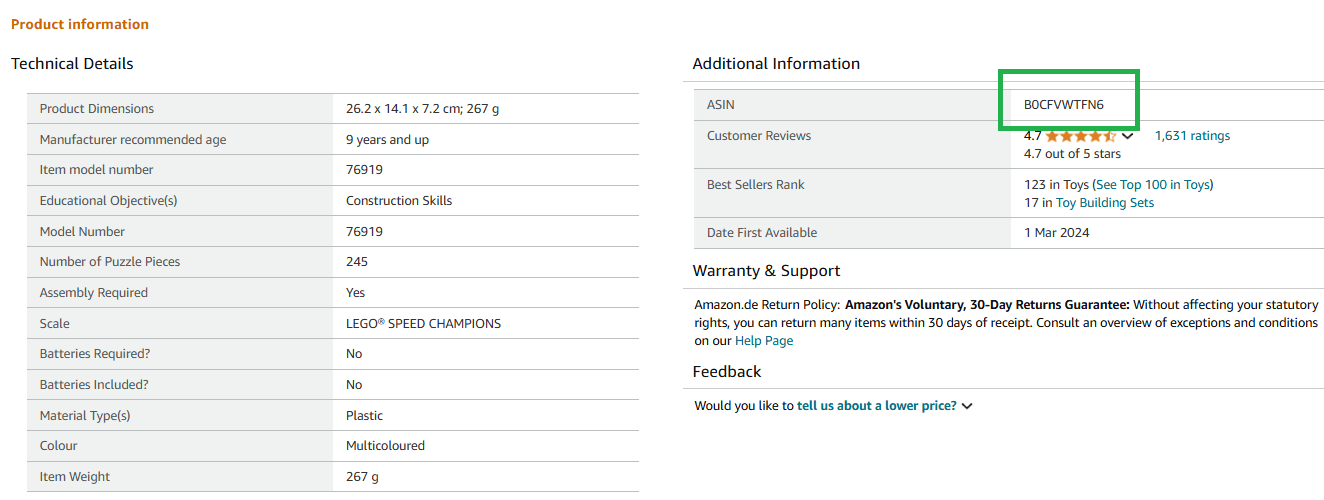
Product details
If you’re a seller looking to add a new offer, you must first check if the item already exists in Amazon’s catalogue under an existing ASIN. Conversely, if you already have the code, you can simply paste it into the Amazon search bar to go straight to the relevant product page.
It’s worth noting that the ASIN doesn’t need to be printed on the product’s physical packaging. This applies even if you are using the Fulfilment by Amazon (FBA) model.
How do you use ASINs when adding products?
A new product automatically gets an ASIN when the listing is created. It’s simply impossible for any item to exist on the platform without an ASIN. This process generally falls into two scenarios:
Listing against an existing ASIN
This applies when another seller has already added the product to Amazon’s catalogue. In this case, you simply add your offer to the existing product page.
As mentioned earlier, you won’t have free rein to change the parameters or description. If the listing needs improvement, you’ll have to raise a case with Seller Support, highlighting the elements you believe need updating to provide a better shopping experience for the customer.
Creating a new ASIN
You will need to create a new Amazon ASIN when the product doesn’t exist on the platform yet – a scenario that primarily applies to manufacturers and private label sellers enrolled in the Amazon Brand Registry.
To add a new product, you’ll use the built-in listing tool directly within your Amazon Seller Central account. You’ll need to provide a title, product description, manufacturer name, and an EAN (or another GTIN-compliant barcode). It’s also vital to fill in the product parameters as thoroughly as possible. Getting this right has a massive impact on your listing’s ranking in the search results.
Why is the ASIN critical for sellers?
We’ve touched on this already, but let’s look at the ASIN strictly from a seller’s perspective. The Amazon Standard Identification Number plays a pivotal role in managing your Amazon business. Here are a few key reasons why understanding its importance is a game-changer:
A tidy product catalogue
Because Amazon uses ASINs to track every item and its variations (like size or colour), the platform can effectively prevent duplicates and differentiate between similar products. This keeps the marketplace organised, making it much easier for customers to find what they’re looking for, while streamlining your seller portfolio.
Search and promotion
The ASIN is instrumental in how products rank on Amazon. It allows you to map the right keywords to your listing, boosting your visibility in search results. This is a foundational element of any promotional strategy, particularly when it comes to advertising and listing optimisation.
Listing management
ASINs make managing your inventory straightforward. They allow you to easily track stock levels, pricing, and sales performance. Organising your portfolio by ASIN also means you can quickly identify and update specific offers when needed.
Optimising advertising campaigns
You simply cannot run effective Amazon PPC (pay-per-click) campaigns without ASINs. They enable precise ad targeting, conversion tracking, and performance monitoring – all of which are essential for maximising the return on your marketing spend.
Buy Box
This is the section on the product page that drives the vast majority of sales, as most customers make their purchase directly through it. Any seller with a product listed under the same ASIN competes for the Buy Box. Optimising your offer under the correct ASIN (by providing competitive pricing, fast shipping times, and reliable stock availability) significantly increases your chances of winning this prime real estate.
GTIN, EAN, and ASIN: What’s the connection?
A Global Trade Item Number (GTIN) is a unique, internationally recognised code assigned to trade items like products, packaging, or services. Developed by GS1, this identification standard is used worldwide and can take various forms, such as EAN-13, UPC, or ISBN, depending on the region and product type.
GTINs allow products to be easily identified and tracked throughout the supply chain, facilitating international trade, warehouse management, and both retail and e-commerce sales. They are a strict requirement for many platforms, including Amazon, when creating new product listings.
On Amazon, a GTIN typically appears as an:
- EAN (European Article Number)
- UPC (Universal Product Code)
- JAN (Japanese Article Number)
Ultimately, the ASIN is closely tied to the GTIN, functioning as Amazon’s own internal product identifier within its catalogue.
Summary
An ASIN isn’t just a product identifier on Amazon; it’s the key to your selling success on the platform. It empowers you to manage your listings precisely, optimise your ad campaigns, and compete fiercely for the Buy Box. Understanding what an ASIN is and how to leverage its potential is the foundation of building a competitive edge in online retail.
Remember, paying attention to the details, presenting your products attractively, and continuously monitoring your performance are the vital steps that will help you stand out from the competition and maximise the opportunities Amazon has to offer.
Ready to scale your brand across European marketplaces? Book a free consultation with our experts today!
Did you find this article helpful?
Average rating 5.0 / 5 — 2 votes
Autor
Marcin Truch
E-commerce Team Leader
I’ve been in e-commerce for over five years, starting in customer service before shifting my focus toward driving sales on webstores and marketplaces. Currently, my deepest expertise lies in managing Allegro and eBay accounts, while I’m constantly evolving my Amazon knowledge. I’m a big believer that user experience—specifically high-quality descriptions and visuals—is the foundation of a successful brand. In my spare time, I’m a petrolhead and a football fan; I’ve also recently rediscovered my love for LEGO thanks to my son.